
Reviewed · WALKING TOURS
2-Hour Historical Walking Tour from Dublin
Dublin’s story comes alive in the space between Trinity College and Dublin Castle, where Viking settlement, British rule, religious conflict, and Irish independence all meet within a compact city center. This two-hour walk uses major landmarks as chapters in Ireland’s past, rather than treating them as isolated photo stops.
I like the low $22.98 price and the small maximum group of 25. I also like the guides’ academic background, with history postgraduate guides such as Jody, Eoin, John, Owen, Daragh, and Caolan bringing plenty of context and personality. The main caution is clear: this is a serious history tour. If you prefer a light stroll focused mainly on buildings, shops, and local food, the political detail may feel heavy.
In This Review
- Key points at a glance
- Why this two-hour walk gives Dublin useful context
- Meeting the guide opposite Trinity College
- Trinity College and the Book of Kells
- The Bank of Ireland and Protestant Ascendancy
- Temple Bar beyond the pub signs
- Wood Quay and Viking Dublin
- The Four Courts and the Irish Civil War
- Christ Church Cathedral and the English invasion
- City Hall and Daniel O’Connell
- Dublin Castle and the Dubh Linn
- What the guides do best
- Is $22.98 good value?
- Practical advice for a better walk
- Should you book this Dublin walking tour?
- FAQ
- How long does the tour last?
- Where does the tour begin?
- Where does the tour end?
- Is entry to the Book of Kells included?
- What language is the tour offered in?
- How large is the group?
- Is the tour suitable for children?
- Can I cancel for a full refund?
Key points at a glance
- A useful first-day orientation: The route gives you a framework for Dublin before you explore Ireland more widely.
- History postgraduate guides: Expect detailed explanations, recent events, political context, jokes, and the occasional song or story.
- Eight central Dublin stops: The walk links Trinity College, Temple Bar, the Four Courts, Christ Church Cathedral, and Dublin Castle.
- Book of Kells context without the admission fee: You hear why the manuscript matters, but entry is not included.
- Compact city-center route: The walk is manageable but lasts a full two hours, sometimes longer.
- Weather matters: Dublin rain and wind can make an outdoor history lesson feel much longer, so wear comfortable shoes and dress well.
Why this two-hour walk gives Dublin useful context
A city tour can either point at buildings or explain why those buildings matter. This one aims for the second approach.
You start with Dublin’s origins, move through medieval invasion and religious division, and then reach the political struggles that shaped modern Ireland. The route includes Viking Dublin, the colonial parliament, the War of Independence, the Irish Civil War, Catholic emancipation, and the handover of power in 1922.
That range is the tour’s greatest strength. I like the way the stops connect different periods instead of keeping each subject in a separate box. When you later pass a Georgian building, a government office, or a cathedral, you will have a better idea of the forces behind it.
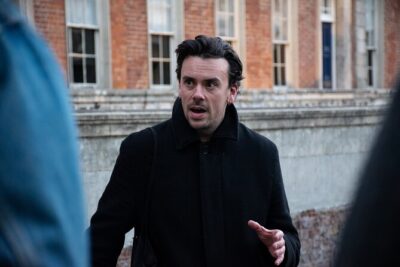
The guides also bring different personalities. Jody is described as animated and theatrical, Eoin as entertaining and clear, John as funny and strong on detail, and Caolan as a newer addition to the guide team. The exact guide depends on the departure, but the common thread is a history graduate who can handle questions and explain complicated events aloud.
The official rating is 4.9 out of 5 from 875 ratings, with 97 percent recommending the experience. That is unusually strong, though you should still match the tour to your interests. One less enthusiastic assessment found the politics and historical detail too dense, and that is a fair warning for anyone hoping for a casual sightseeing walk.
More walking tours in Dublin:
- Dublin Highlights and Hidden Gems Guided Walking Tour
★ 5.0 · 6,020 reviews - Dublin: Highlights and Hidden Gems Walking Tour
★ 4.9 · 2,140 reviews - 1916 Rebellion Walking Tour
★ 5.0 · 1,605 reviews
Meeting the guide opposite Trinity College
The starting point is the Henry Grattan Monument, also called the Grattan statue, on College Green. It is opposite the front gate of Trinity College, not at the gate itself.
That distinction matters. A participant once waited by the Trinity gates and missed the guide because of incorrect map information. The meeting point has been the statue for several years, and the guide may try to contact you using the mobile number attached to your booking.
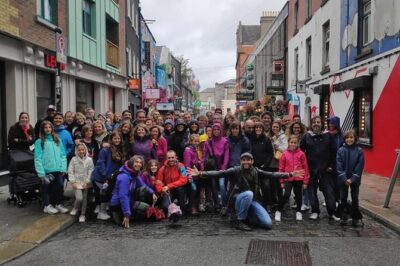
Arrive with enough time to identify the monument and gather with the group. The tour is offered in English, uses a mobile ticket, and begins near public transport. The group can reach 25 people, so this is not a private walk, but it is still much more contained than a large open gathering.
The location is excellent for a first Dublin activity. College Green is central, easy to reach, and close to several of the city’s main sights. The route finishes at Christ Church Cathedral, so you can continue exploring the medieval quarter, stop for lunch, or visit the cathedral if you want to pay for admission separately.
Trinity College and the Book of Kells
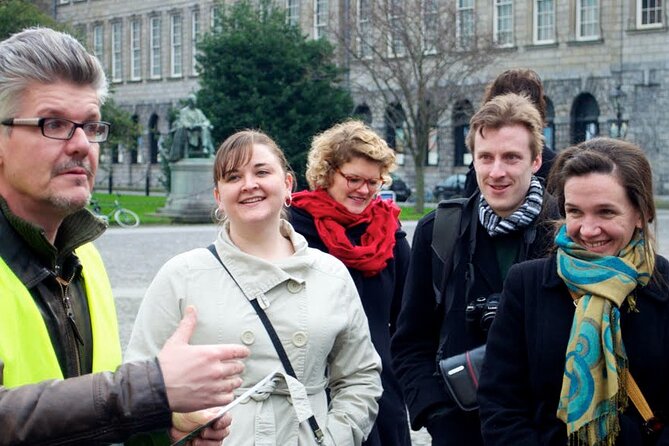
The first stop lasts about 20 minutes and takes place around Trinity College, Ireland’s oldest university, founded in 1592.
The guide explains the college’s role in Dublin and introduces its most famous object, the Book of Kells. This eighth-century manuscript contains the four Gospels in Latin. Even if you do not enter the exhibition, understanding the manuscript’s age and place in Irish culture adds meaning to the college visit.
Entry to the Book of Kells is not included. That is useful to know before you arrive, since the walk provides background rather than an admission visit. You can choose to return later if seeing the manuscript is a priority, but the tour itself keeps moving.
This opening works well because it gives you a firm starting point. Trinity is not just an old university with an attractive courtyard. It is a doorway into questions of education, religion, identity, and power that recur throughout the rest of the walk.
The Bank of Ireland and Protestant Ascendancy
Next comes the Bank of Ireland, once Ireland’s colonial parliament. The building dates from 1729 and reflects the neo-classical taste of the period.
The parliament was abolished by the Act of Union in 1800. The guide uses the building to explain Protestant Ascendancy, the system in which political and economic power was concentrated among Ireland’s Protestant ruling class during the 18th century.
You spend about ten minutes here. That is enough time to understand why this grand building mattered, even though the stop is not an interior tour. The value comes from connecting architecture to the society that commissioned it.
This section may be one of the points where the tour becomes more political than scenic. If you want to understand why Irish history contains so much tension around religion, representation, and British rule, this is essential groundwork.
More history walks in Dublin:
- Dublin Historical Centre Food Tour with 8 Food Tastings & Drinks
★ 5.0 · 1,718 reviews - Historical 2-Hour Guided Walking Tour of Dublin
★ 4.7 · 865 reviews - Dublin to Cork, Blarney Castle & Cóbh Heritage Centre by train
★ 4.5 · 510 reviews - Dublin: Jeanie Johnston Tall Ship Irish Famine History Tour
★ 4.8 · 431 reviews
Temple Bar beyond the pub signs
Temple Bar is usually presented to visitors as Dublin’s nightlife district, but the tour gives you a different angle.
The narrow-street area was once earmarked for demolition. In the 1990s, it was repurposed as Dublin’s Cultural Quarter. The guide explains that change in about ten minutes, showing how a district’s public identity can shift from threatened neighborhood to major visitor attraction.
This is a short stop, but it helps you look past the familiar pub fronts and busy lanes. You see Temple Bar not only as a place to eat or listen to music, but as a case study in urban planning and cultural policy.
Do not expect a long break here. The walk is focused on explanation, not browsing. You can return on your own later if you want time for shops, food, or the area’s evening atmosphere.
Wood Quay and Viking Dublin
At Wood Quay, the subject reaches much further back. Extensive archaeological work in the 1980s uncovered evidence of the Viking city, founded around AD 840.
The amphitheater area offers a chance to picture Dublin before its later cathedrals, Georgian buildings, and political institutions. The guide places the modern city within its early settlement story and explains why the riverfront mattered.
You spend about ten minutes here. There may not be a dramatic structure to enter, so this stop depends heavily on the guide’s ability to make archaeology and early urban development understandable.
I find this kind of stop valuable because it prevents Dublin’s story from beginning with English rule. The city existed long before that period, and the Viking chapter is a key part of its identity.
The Four Courts and the Irish Civil War
The 20-minute stop at the Four Courts is one of the most politically important parts of the walk.
The Four Courts is Ireland’s legal headquarters. It is also associated with the beginning of the Civil War in June 1922, when forces supporting and opposing the Treaty of December 1921 came into conflict.
That treaty had ended the War of Independence of 1919 to 1921, but it split the independence movement. The disagreement was not a minor footnote. It shaped the new Irish state and left political divisions that lasted for generations.
This is where the tour’s academic approach is most apparent. You are not just told that the building is important. You get the chain of events that explains why it became a flashpoint.
For some people, this will be the strongest stop. For others, it may be hard to follow, especially if Irish political history is new to you. Pay attention to the basic sequence: War of Independence, treaty, disagreement, Civil War. Once that framework is clear, the rest becomes easier to place.
Christ Church Cathedral and the English invasion
Christ Church Cathedral is Dublin’s oldest cathedral, founded in 1030 and rebuilt in stone in the 1170s.
The guide connects the rebuilding to Strongbow, a central figure in the original English invasion of the 1170s. That makes the cathedral more than a religious monument. It becomes evidence of the moment when outside political power began to reshape Dublin.
The stop lasts about ten minutes. You should not confuse this with a full cathedral visit. The route ends at Christ Church, but admission is not listed as included, and the guided portion concentrates on history from outside.
The cathedral is a fitting end point because so many earlier themes meet here: Viking Dublin, medieval Christianity, English intervention, and the city’s transformation under new rulers. If you want to enter, you can plan that separately after the walk.
City Hall and Daniel O’Connell
At City Hall, the guide introduces Daniel O’Connell, represented inside by a statue.
O’Connell became Dublin’s first Catholic Lord Mayor in 1840 and led the campaign for Catholic Emancipation in 1829. That movement ended anti-Catholic laws and earned him the title The Liberator.
This stop shows how religious restrictions affected public life and political participation. It also brings the story back to a person, which can make a large political subject easier to remember.
The visit lasts about ten minutes. Since the statue is inside City Hall, conditions for viewing it may depend on access at the time of the walk, so treat the stop as an explanation of O’Connell’s importance rather than a guaranteed extended interior visit.
Dublin Castle and the Dubh Linn
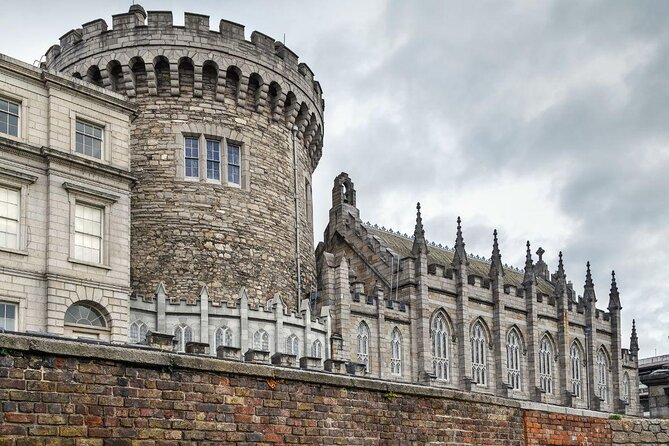
The last major stop is Dublin Castle, built by King John in 1204.
For centuries, it served as the seat of British administration in Ireland, until 1922. The site also relates to the Dubh Linn, or Black Pool, from which Dublin gets its name.
That makes the castle a strong closing point. You finish with both the city’s name and the political institution that represented British rule. The walk has moved from a university and parliament to medieval conquest, law, religion, independence, and the transfer of power.
The castle area is also practical for the rest of your day. From here, you are close to central museums, shopping streets, cafés, and other historic sites. The formal tour ends at Christ Church Cathedral, but the castle stop gives you a clear sense of the surrounding old city.
What the guides do best
The strongest part of this experience is the spoken presentation.
The guides are history postgraduates, and the best examples combine facts with stories, humor, and a clear sense of sequence. Jody is noted for linking thousands of years of Irish history through to Brexit, while Eoin is praised for an easy-to-follow overview and a voice that carries well outdoors. Other guide feedback highlights songs, colorful stories, and recent history alongside older events.
You should expect a lot of information. One guide reportedly began with a five-minute overview covering 5,000 years, then added detail at each stop. That is a good description of the tour’s method: broad framework first, closer explanation later.
The pace seems to suit adults and older children who enjoy history. Younger children may struggle with the political sections. You also need to be comfortable standing and walking for two full hours, or possibly two and a half if the guide runs over.
Is $22.98 good value?
At $22.98 per person, this is a sensible way to get a city orientation without paying for several separate admissions.
All listed stops are viewed without an admission charge, and the Book of Kells is not included. That keeps the price down, but it also means you are paying mainly for the guide’s time and preparation. In this case, that is the point of the experience.
The group maximum of 25 helps preserve some personal contact while keeping the cost below a private tour. You can ask questions, hear the guide, and then revisit the places that interest you most later.
The value is best if you take the tour near the beginning of your Dublin stay. It can help you understand why Trinity, Temple Bar, the Four Courts, Christ Church, and Dublin Castle matter before you explore them independently.
Practical advice for a better walk
Wear comfortable shoes. The route is not described as difficult, but two full hours on city streets is still a fair amount of walking.
Dress for Dublin’s weather, not the forecast you wish you had. Rain, wind, and cold have all been part of people’s experience, and a good guide can keep the talk lively, but no guide can make wet shoes comfortable.
Keep your phone charged and use the correct meeting point. Go to the Grattan statue opposite Trinity College’s front gate, not the gate itself.
Service animals are allowed, and the tour is near public transportation. A moderate level of physical fitness is expected. Since the tour is in English, you should also be comfortable following extended explanations of Irish political and religious history in that language.
Free cancellation is available up to 24 hours before the start time for a full refund. Changes or cancellations made less than 24 hours ahead are not accepted for a refund.
Should you book this Dublin walking tour?
Book it if you want a serious introduction to Dublin and Ireland, especially at the start of your trip. The price is modest, the route covers major central sights, and the history postgraduate guides can give you far more context than a quick photo walk.
Think twice if you want mostly culture, architecture, food, or casual city banter. The political material is central, not incidental, and the tour can run beyond two hours. It is also weather dependent because the experience takes place outdoors.
For history fans, curious first-time visitors, and anyone who wants Dublin’s buildings to make more sense, this is a strong buy. Bring a coat, comfortable shoes, and the willingness to concentrate. You will leave with a clearer map of the city and a much better idea of how Ireland got from Viking settlement to the modern state.
FAQ
How long does the tour last?
The tour lasts approximately two hours, though it may run longer. Some guided walks have lasted about two and a half hours.
Where does the tour begin?
It begins at the Henry Grattan Monument, also called the Grattan statue, on College Green opposite the front gate of Trinity College Dublin.
Where does the tour end?
The listed end point is Christ Church Cathedral on Christchurch Place, near Wood Quay.
Is entry to the Book of Kells included?
No. The tour explains the importance of the Book of Kells, but entry to see it is not included.
What language is the tour offered in?
The tour is offered in English.
How large is the group?
The maximum group size is 25 people.
Is the tour suitable for children?
The supplied information says participants should have a moderate level of physical fitness. The historical detail may be better suited to older children and teenagers than to very young children.
Can I cancel for a full refund?
Yes. You can cancel at least 24 hours before the experience start time for a full refund. Cancellations or changes made less than 24 hours before the start time are not accepted for a refund.
More 2-Hour Experiences in Dublin
- 2 Hour Walking Tour of Dublin’s City Centre
★ 5.0 · 63 reviews - Dublin: 2-Hour Premium Whiskey and Food Tasting Tour
★ 4.7 · 54 reviews - Dublin: 2 Hour City Center Guided Walking Tour
★ 4.9 · 12 reviews - 2-Hour Deluxe Whiskey & Food Tasting
★ 4.6 · 9 reviews
Just added around Dublin
- Dublin: Pub Tour. Pour The Perfect Guinness, Whiskey & Music★ 5.0 · 3 reviews
- A Self Guided Walking Tour of Dublin’s Docklands★ 4.5 · 3 reviews
- Private Dublin City tour★ 5.0 · 3 reviews
- Dublin One Day Tour with a Local: 100% Personalized & Private★ 4.5 · 3 reviews
- Waterford Crystal and Kilkenny Full-Day Rail Tour from Dublin★ 5.0 · 3 reviews
- Secret and unusual Dublin: guided walking tour★ 5.0 · 3 reviews
- 5 Day Ireland’s South−East Including Admission from Dublin★ 4.5 · 3 reviews
- Turtle Bunbury’s Dublin: A Self-Guided Audio Tour from a Celebrated Author★ 5.0 · 3 reviews
Walking Tours, compared.
Dublin Highlights and Hidden Gems Guided Walking Tour
Read our review →
90 Minute Dublin Walking tour and Sightseeing tips
Read our review →
Dublin Traditional Irish 3 Course Meal Walking Tour with Local
Read our review →
Browse the lists this tour appears in