
Reviewed · WALKING TOURS
Private Guided Walking Tour in Dublin
Dublin’s story is easiest to grasp on foot, where a modern shopping street can suddenly give way to a medieval wall, a Viking settlement, or a church that has served worshippers since the 12th century. This private walk links those layers in a compact route through the old city, with local guide Ben providing the historical thread.
I like the one-on-one format, which lets you stop and ask about anything that catches your eye instead of following a fixed group script. I also like the unusual souvenir: a video route map with captioned photos, short clips, and music, giving you a useful memory of the walk after you leave.
The main consideration is the walking. The tour lasts from about 2 hours 20 minutes to 3 hours 30 minutes, depending on the pace and stops, and includes cobbled streets, hills, and plenty of standing. A medieval church visit is also subject to opening times, so you should view that part as a bonus rather than a guarantee.
In This Review
- Key points about this Dublin walk
- Starting at City Hall and the old Royal Exchange
- Parliament Street, Temple Bar, and the medieval city edge
- Fishamble Street and the Viking settlement at Wood Quay
- Christ Church Cathedral and the Norman city
- St. Audoen’s Church and the surviving city wall
- The Brazen Head, Dublin’s oldest pub
- The Liberties, old markets, and neighborhood names
- St. Patrick’s Cathedral and centuries of change
- Dubh Linn Gardens and Dublin’s name
- Dublin Castle and the route back to City Hall
- What the private format is worth
- Pace, comfort, and who should book
- Should you book this Dublin walking tour?
- FAQ
- Where does the private Dublin walking tour start?
- Where does the tour finish?
- How long does the tour last?
- How many people can join the private tour?
- Is entry to a medieval church included?
- Are food and drinks included?
- What happens if the weather is poor?
Key points about this Dublin walk
- A private group of up to 15: You explore with your own party rather than joining strangers.
- Dublin’s oldest layers in one route: The walk connects Viking Dublin, the medieval walled city, British administration, the Liberties, and modern civic life.
- Important church stops: Christ Church Cathedral, St. Audoen’s Church, and St. Patrick’s Cathedral each reveal a different part of Dublin’s past.
- A guide who invites questions: Ben’s approach includes humor, clear explanations, photographs, and practical suggestions for the rest of your stay.
- A useful digital souvenir: Your route map includes captioned images, video clips, and music.
- Good value for a small group: At $200.62 for up to 15 people, the cost becomes especially attractive when shared among several people.
Starting at City Hall and the old Royal Exchange
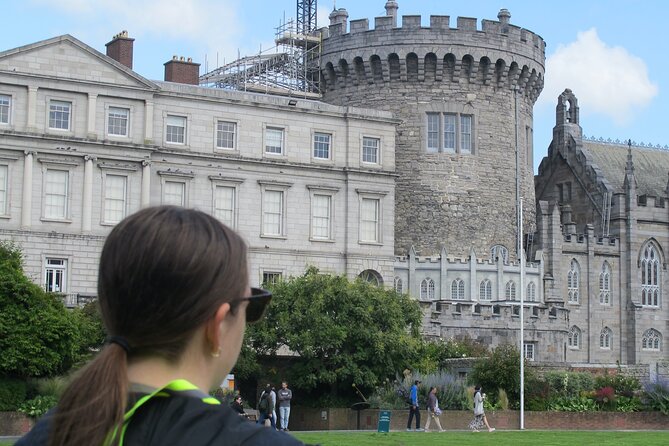
Meet at the Dublin Tourist Information Centre in Barnardo Square, beside Palace Street in Dublin 2. The location puts you right in the old center, so the tour begins with history rather than a long transfer from the city outskirts.
The first major stop is City Hall. The building dates from the 18th century, when it served as the Royal Exchange. It later became the headquarters of Dublin Corporation, the city authority, before that administration moved to Wood Quay.
Today, City Hall has a more varied role. It can host civic functions, weddings, and even film shoots. That change in use makes it a handy opening lesson: Dublin’s historic buildings are not museum pieces only. They remain part of daily city life.
This first stop also gives your guide a chance to explain how Dublin developed as a center of trade and administration. You are not simply looking at a handsome facade. You are beginning to see how power, commerce, and city government occupied the same small area.
More walking tours in Dublin:
- Dublin Highlights and Hidden Gems Guided Walking Tour
★ 5.0 · 6,020 reviews - Dublin: Highlights and Hidden Gems Walking Tour
★ 4.9 · 2,140 reviews - 1916 Rebellion Walking Tour
★ 5.0 · 1,605 reviews
Parliament Street, Temple Bar, and the medieval city edge
From City Hall, the walk continues along Parliament Street. This stretch brings several small historical details into view, including Dublin’s oldest shop and a hotel building that once served as the city’s custom house in the 17th century.
These are the kinds of details that are easy to miss alone. You might walk past a shopfront or hotel entrance without realizing that the building once handled goods, taxes, or trade. A private guide can pause when the street itself offers a clue.
You also get a look at Temple Bar. This is one of Dublin’s best-known districts, and it can feel crowded and commercial, especially at popular times. The value here is not necessarily lingering in the district. Instead, you see where Temple Bar fits within the older city, rather than treating it as an isolated nightlife quarter.
The route then turns along Essex Gate. The cobbled street takes its name from an entrance that once led through the medieval walls. That name is a small but useful reminder that Dublin’s street plan still preserves traces of the walled city.
Fishamble Street and the Viking settlement at Wood Quay
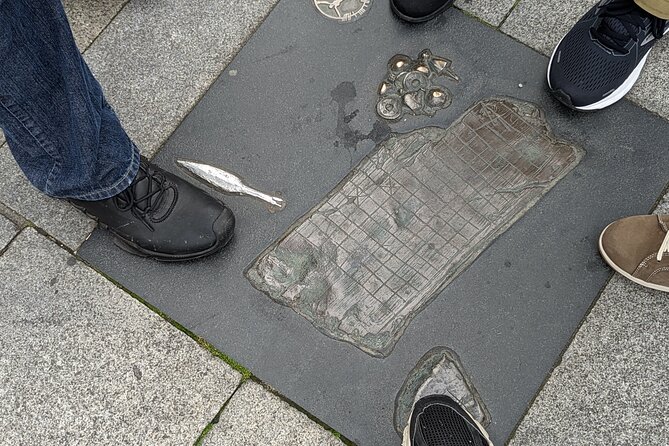
Essex Gate leads toward the area around Wood Quay, where an ancient Viking settlement once occupied the riverfront. A Viking longboat placed here serves as a visual reminder of the visitors who arrived in Dublin by water, though they were hardly welcome in the usual tourist sense.
The walk then reaches Fishamble Street, described as Dublin’s oldest street. Its name refers to the fish market that once operated here, giving you another example of how old street names preserve the work that took place in medieval Dublin.
This section is particularly good for understanding the city as a working settlement. Dublin’s past was not only kings, cathedrals, and battles. It was also fish sellers, merchants, craftspeople, traders, and people living close to the river and city walls.
Expect the guide to add stories along the way rather than deliver one long lecture. Ben is known for mixing historical explanation with Irish humor, and the private format makes it easier to ask about names, customs, or events that interest your group.
Christ Church Cathedral and the Norman city
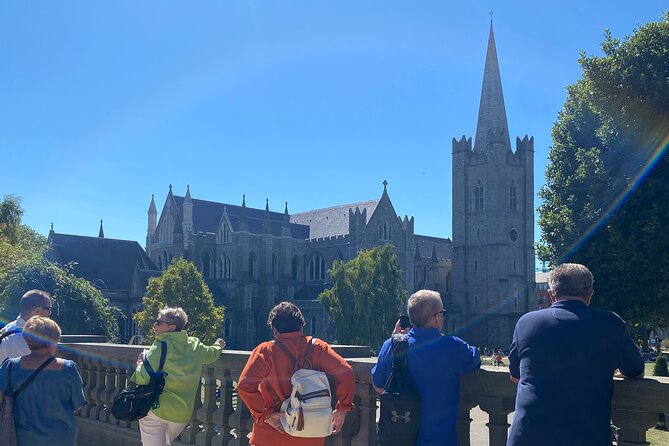
Christ Church Cathedral is one of the central sights on the route. The Normans built it in the 12th century, and its position above the surrounding streets gives it real visual force, even when you are seeing it from the outside.
The stop focuses on the cathedral’s setting, stories, and photo opportunities. The information provided does not promise an interior visit here, so you should not book this walk expecting a guaranteed tour inside Christ Church.
That is not a serious flaw if your goal is to understand Dublin’s historic center. The cathedral is part of a wider sequence, and the guide helps place it within the Norman reshaping of Dublin. If entering the cathedral is essential to you, check its separate opening hours and admission arrangements.
The nearby cobbled streets also help you sense the scale of the old city. Dublin’s major landmarks are close together, but the route does involve uneven surfaces and changes in elevation. Comfortable shoes are not optional decoration here. Wear the pair you would choose for several hours of city walking.
A few more Dublin tours worth weighing up
- The Dublin Private Walking Tour
★ 5.0 · 701 reviews - Private Dublin Arrival Transfer – Airport to Hotel / Accommodation
★ 3.5 · 304 reviews - Private (Nearly!) All of Dublin in 5 hours (Walking Tour)
★ 5.0 · 281 reviews - Cliffs of Moher Private Award Winning Luxury Mercedes Car Tour
★ 5.0 · 176 reviews
St. Audoen’s Church and the surviving city wall
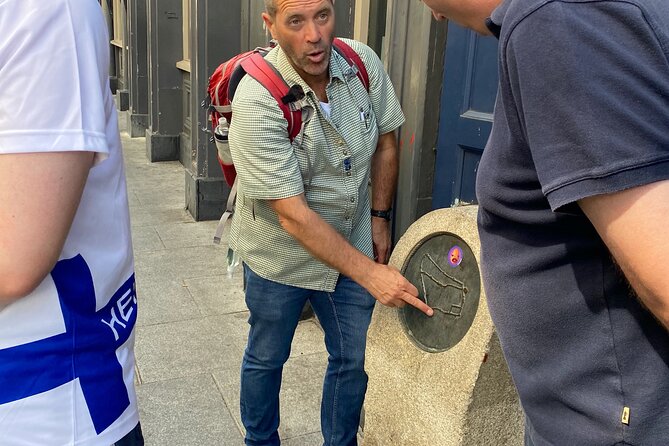
After crossing Winetavern Street, the route moves through a residential area. That is a useful change of mood. This part of Dublin has remained residential from medieval times into the present, showing how old land uses can survive beside major monuments.
At Cook Street, you see one of the longest and oldest remaining sections of the medieval city wall. The wall is more than a backdrop for photographs. It helps you understand the physical boundary of medieval Dublin and the difference between life inside and outside the fortified city.
The route passes the Gates of Hell before reaching St. Audoen’s Church. Services have continued here since the 12th century, making it one of the most meaningful stops on the walk. From April through October, you can visit the church and visitor center between the stories of prayer, guilds, burials, and neighborhood life.
Admission is included, but entry depends on opening times. This is one of the tour’s clearest seasonal limitations. If your Dublin visit falls outside April to October, or if the church is closed when you arrive, you may see the exterior and hear the explanation without entering.
The stop is listed at about 20 minutes, which is enough for a focused visit but not an exhaustive church tour. I see that as a sensible balance. The experience covers several major sites, so it cannot spend an hour inside every building.
The Brazen Head, Dublin’s oldest pub
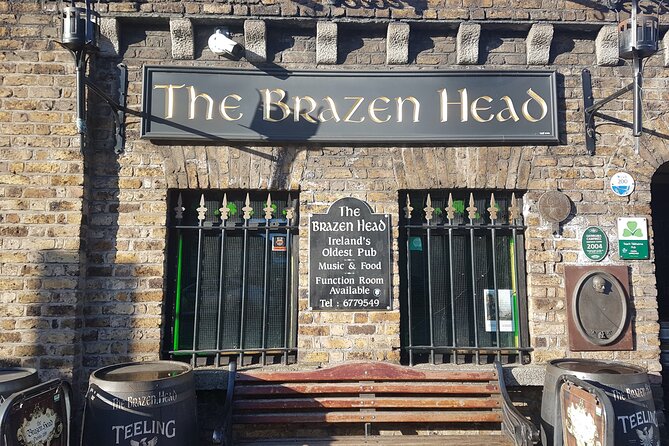
The Brazen Head adds a distinctly Dublin pause to the historical route. The pub traces its establishment to 1198, the same year associated with the death of Ireland’s last High King, Rory O’Connor.
Its name is linked to braziers, barrels of burning fuel used to warm the hands of people passing on cold nights. The story gives the pub a strong connection to the practical, rough-edged life of old Dublin.
You can stop for a drink if you wish, but refreshments are not included in the tour price. The scheduled stop is about 15 minutes, so this is more of a short pub interlude than a full meal or pub crawl.
That distinction matters. If you want an evening of pints, music, and long conversation, book a separate pub experience. Here, the pub works as a historical landmark and an optional place to pause.
The Liberties, old markets, and neighborhood names
The route doubles back briefly and climbs uphill along the former perimeter of the medieval city. This section leads into the Liberties, one of Dublin’s oldest neighborhoods and one of the most characterful parts of the walk.
You pass St. Nicholas of Myra, the former Iveagh Market, and streets named for figures including Dean Swift, John Dillon, and Thomas Davis. These names offer a quick lesson in how Dublin remembers writers, politicians, reformers, and local institutions through its street signs.
The old market is particularly interesting because it points to the district’s working identity. The Liberties is not presented as a polished historic zone separated from ordinary life. Its importance comes from the way homes, churches, markets, breweries, and civic stories overlap.
An arched alley leads toward St. Patrick’s Cathedral. By this point, you have moved through several distinct parts of central Dublin without relying on a bus or taxi. That makes the route useful early in your visit, since you can recognize the streets and landmarks later when exploring independently.
St. Patrick’s Cathedral and centuries of change
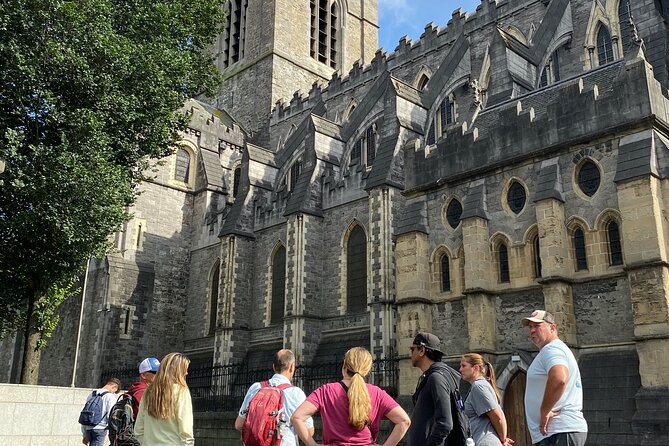
St. Patrick’s Cathedral is presented as the rival to Christ Church Cathedral. The stop gives you time to take in the cathedral and its gardens while tracing events from the Vikings and Normans through the Reformation, Oliver Cromwell, Guinness, and the later life of the cathedral.
The scheduled visit is about 10 minutes and admission is listed as free for the tour stop. This is an exterior viewing point rather than a promised interior cathedral visit. The gardens provide seating, and an outdoor cafe may tempt you if the weather and timing cooperate.
The contrast between St. Patrick’s and Christ Church is one of the route’s strongest themes. Instead of treating the cathedrals as interchangeable old churches, the guide frames them as competing centers with different settings and stories.
If you want to explore St. Patrick’s interior at length, set aside extra time outside the walking tour. Ten minutes is enough for orientation and photographs, not a full cathedral visit.
Dubh Linn Gardens and Dublin’s name
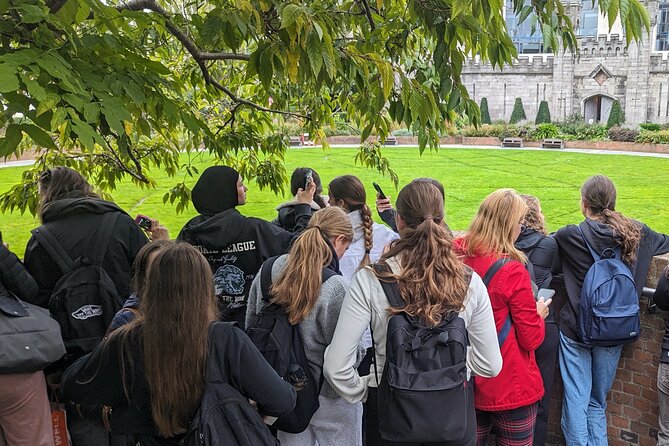
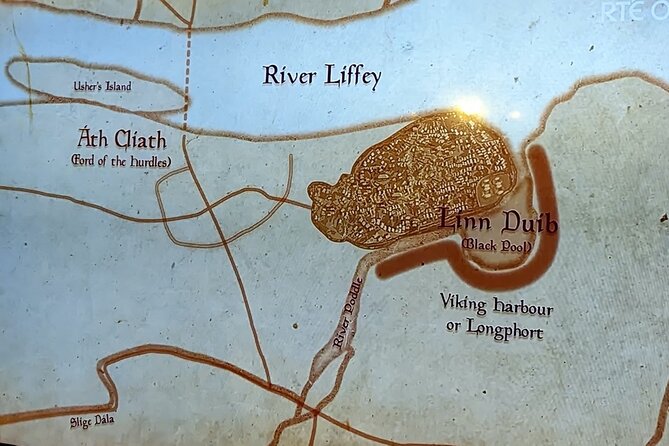
After leaving St. Patrick’s, the route loops back toward another intact section of the Norman walls along the southern edge of the medieval city. The walk then reaches Dubh Linn Gardens, a quiet city-center space with a story tied directly to Dublin’s name.
Dubh Linn means dark pool, and the circular garden marks the area associated with that old body of water. This is a short stop of about 10 minutes, but it provides a welcome pause after the churches and cobbled streets.
You also see the Garda Memorial, the David and Goliath statue, and a tribute to the Special Olympics. The guide points out the Chester Beatty Museum and Library as well, giving you a useful option for later independent sightseeing.
I like this part because it connects a place name to the physical city. You are not only hearing that Dublin has Viking and medieval roots. You are standing in a modern garden where the old name still points back to the landscape that shaped the settlement.
Dublin Castle and the route back to City Hall
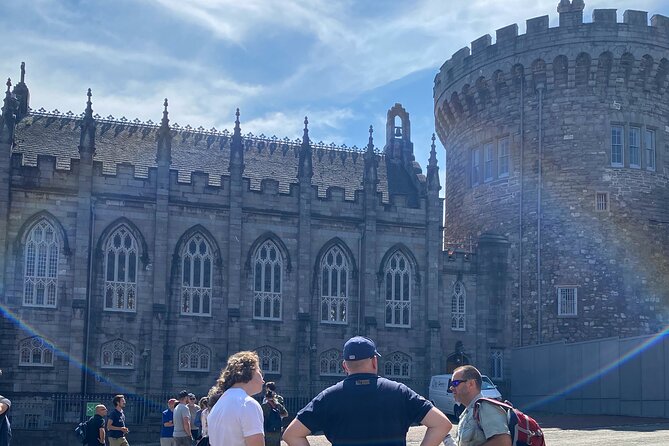
The final major stop is Dublin Castle, which served as the center of government administration while Ireland was under British rule. Its buildings bring together 12th-century remains and later 18th-century architecture, making the castle a clear example of Dublin’s layered political past.
You hear about the Record Tower and the 16th-century escape of the last Gaelic chiefs. The story gives the castle more drama than a simple look at government offices and courtyards.
The stop lasts about 10 minutes and takes place around the castle grounds rather than as a guaranteed interior tour. If you want to visit the State Apartments or other interior rooms, plan a separate visit and allow extra time.
The route passes through the courtyard and exits near City Hall, returning to the original meeting point. Ending where you started is convenient, especially if you want to continue to Temple Bar, the castle, or another central attraction without arranging transport.
What the private format is worth
The cost is $200.62 per group of up to 15 people. For one or two people, that is a significant price for a walking tour. For a family or group of friends, the calculation changes quickly. Split among 10 people, the cost is roughly $20 per person, and with 15 people it is about $13.40 per person.
The private format is the main value. You can ask questions freely, adjust the pace within reason, and request practical advice for the rest of your Dublin stay. Ben has provided suggestions for dinner spots, further sightseeing, and places such as the Book of Kells on related experiences, so you can use the walk as a planning session as well as a history lesson.
You also receive a mobile ticket and a video route map with captioned photographs, video clips, and music. That is more useful than a generic souvenir because it helps you remember the exact streets and landmarks you encountered.
Keep your expectations realistic. The price does not include snacks, drinks, or refreshments, and the short stops at the cathedrals are not substitutes for full paid admissions. You are paying for a personal guide, historical context, and an efficient introduction to central Dublin.
Pace, comfort, and who should book
Most people can participate, and the tour is near public transportation. Service animals are allowed. Still, this is a genuine walking experience with cobbles, uphill stretches, and several hours of movement, so anyone with mobility concerns should think carefully about comfort and ask the provider for current route details.
The time range is unusually broad, from approximately 2 hours 20 minutes to 3 hours 30 minutes. That flexibility can work well for a private group, but do not schedule a tight airport transfer or timed attraction immediately afterward.
I would book this early in a Dublin visit. The route gives you a working map of the historic center, and the guide can point you toward places to return to at your own pace. It suits first-time visitors, families who want a private pace, cruise passengers with a full day in port, and anyone who prefers conversation to a large headset group.
It is less suitable if you want long interior visits at Christ Church, St. Patrick’s Cathedral, or Dublin Castle. It is also not the best choice if you dislike walking on uneven streets or want a food-and-drink tour rather than a historical overview.
The tour requires good weather. If poor weather cancels it, you are offered another date or a full refund. You can cancel for a full refund up to 24 hours before the start time, but changes or cancellations inside that window are not accepted.
Should you book this Dublin walking tour?
Book it if you want Dublin’s old center explained by a local guide, with time for questions and the freedom of a private group. The route covers an impressive range: City Hall, Temple Bar, Fishamble Street, the Viking settlement at Wood Quay, Christ Church, St. Audoen’s, the Liberties, St. Patrick’s, Dubh Linn Gardens, and Dublin Castle.
The strongest reasons to choose it are Ben’s personal, conversational approach, the chance to shape the experience around your interests, and the efficient route through the medieval core. The video route map is a nice extra, especially if you want a record of the streets and landmarks.
Skip it if your priority is entering every cathedral, spending a long time in museums, or avoiding hills and cobblestones. For a small group that wants history, local perspective, and a useful first look at Dublin, the $200.62 group price can be very good value.
FAQ
Where does the private Dublin walking tour start?
It starts at the Dublin Tourist Information Centre in Barnardo Square, 3 Palace Street, Dublin 2, D02 T277, Ireland.
Where does the tour finish?
The walk returns to the original meeting point near the Dublin Tourist Information Centre.
How long does the tour last?
The approximate duration is between 2 hours 20 minutes and 3 hours 30 minutes. Walking time between attractions is included.
How many people can join the private tour?
The price covers one private group of up to 15 people. Only your group participates.
Is entry to a medieval church included?
Entrance to the medieval church and visitor center is included, subject to opening times. St. Audoen’s Church and visitor center can be visited between April and October, depending on access.
Are food and drinks included?
No. Snacks, refreshments, and drinks are not included. The Brazen Head stop gives you the option to purchase a drink, but you pay separately.
What happens if the weather is poor?
The experience requires good weather. If it is canceled because of poor weather, you are offered a different date or a full refund.
Just added around Dublin
- Dublin: Pub Tour. Pour The Perfect Guinness, Whiskey & Music★ 5.0 · 3 reviews
- A Self Guided Walking Tour of Dublin’s Docklands★ 4.5 · 3 reviews
- Private Dublin City tour★ 5.0 · 3 reviews
- Dublin One Day Tour with a Local: 100% Personalized & Private★ 4.5 · 3 reviews
- Waterford Crystal and Kilkenny Full-Day Rail Tour from Dublin★ 5.0 · 3 reviews
- Secret and unusual Dublin: guided walking tour★ 5.0 · 3 reviews
- 5 Day Ireland’s South−East Including Admission from Dublin★ 4.5 · 3 reviews
- Turtle Bunbury’s Dublin: A Self-Guided Audio Tour from a Celebrated Author★ 5.0 · 3 reviews
Walking Tours, compared.
Dublin Highlights and Hidden Gems Guided Walking Tour
Read our review →
90 Minute Dublin Walking tour and Sightseeing tips
Read our review →

Dublin Traditional Irish 3 Course Meal Walking Tour with Local
Read our review →

Browse the lists this tour appears in