
Reviewed · WALKING TOURS
Dublin Private Walking Tour | 3 hour Highlights & Hidden Gems
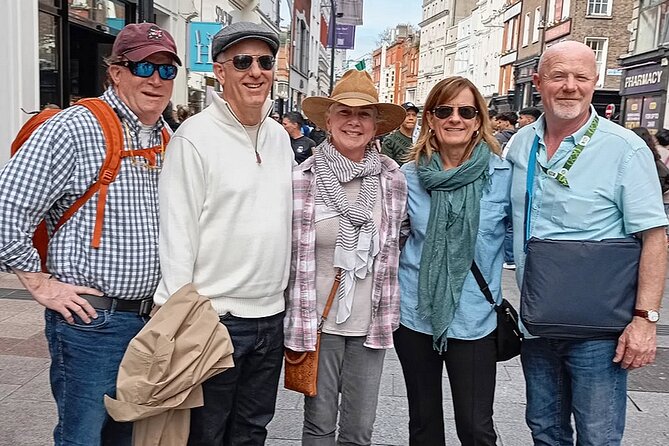
Dublin’s story comes alive best on foot, and this private tour packs a lot into three hours. With David as your guide, you move from Dublin Castle and Trinity College to the Famine Memorial, the 1916 Rising, Irish music, and quiet corners that are easy to miss on your own. He adds songs, photographs, and personal stories to the usual monuments.
I like the private format, since you can ask questions and adjust the route to suit your plans. I also like the practical touch: David provides a digital guide to cafes, restaurants, pubs, and traditional music venues, along with advice on transport and getting around.
The main consideration is pace. Fourteen stops in three hours means most places receive a short introduction rather than a long visit. Paid attractions are not included, and the castle and Trinity College are viewed from outside.
In This Review
- Key points to know before booking
- A smart first look at Dublin’s story
- Dublin Castle and the roots of the city
- Trinity College, College Green, and the old Parliament
- Temple Bar beyond the famous pub
- Crossing the Ha’penny Bridge
- Powerscourt Townhouse and St Stephen’s Green
- Dubh Linn Gardens and the famine memorial
- Wolfe Tone, Dame Lane, and the 1916 Rising
- What David adds to the walk
- Price, timing, and practical value
- Who will get the most from this Dublin walk
- Should you book it?
- FAQ
- How long is the Dublin Private Walking Tour?
- Where does the tour start?
- Where does the tour end?
- Is the tour private?
- Is Dublin Castle included inside the tour?
- Does the tour enter Trinity College?
- Are food and drinks included?
- Is the tour suitable for young children?
- What language is the tour offered in?
- Can I cancel for a refund?
Key points to know before booking

- David brings history to life with songs, photos, humor, and stories rather than giving only dates and names.
- The route covers 14 central Dublin stops, including Dublin Castle, Trinity College, Temple Bar, St Stephen’s Green, and the Famine Memorial.
- It is fully private, so your group gets the guide’s attention and may request a more useful finishing point.
- The tour connects major themes in Irish history, from medieval Dublin and British rule to the 1798 rebellion and 1916 Rising.
- The $144.03 per-person price buys a personal orientation, local recommendations, and three hours of guiding, but value depends heavily on group size.
- You should be ready to walk and listen, with no food, drinks, or paid attraction entries included.
A smart first look at Dublin’s story
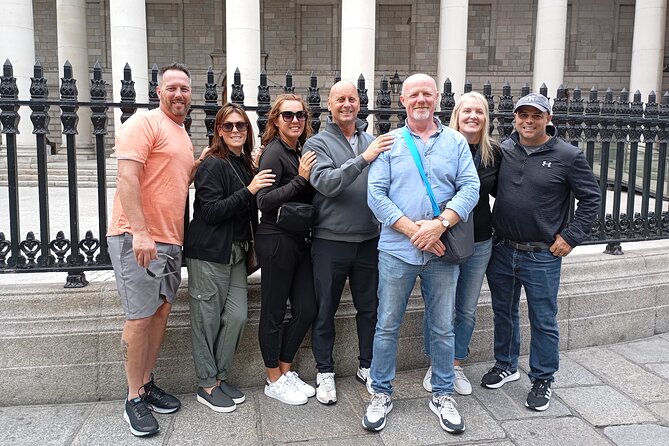
The tour begins at the Molly Malone statue on Suffolk Street, a handy central meeting point near several of the city’s main sights. Molly comes from Dublin’s famous song, and the statue has become one of the city’s most photographed meeting places.
This is a good starting point because you are not simply pointed toward a monument and sent on your way. David uses the statue to introduce Dublin’s character, local traditions, and the way songs and folklore shape the city’s identity.
From there, the route forms a broad loop through central Dublin. The stops are close enough to link into one walk, but the schedule is carefully packed. The listed stops add up to about three hours, so the tour is more of a guided city orientation than a series of extended site visits.
That distinction matters. If you want to enter Dublin Castle, spend hours with the Book of Kells, or linger in the National Gallery, you will need separate time. If you want a connected explanation of what you are seeing, this format works well.
More walking tours in Dublin:
- Dublin Highlights and Hidden Gems Guided Walking Tour
★ 5.0 · 6,020 reviews - Dublin: Highlights and Hidden Gems Walking Tour
★ 4.9 · 2,140 reviews - 1916 Rebellion Walking Tour
★ 5.0 · 1,605 reviews
Dublin Castle and the roots of the city
Dublin Castle receives about 20 minutes, making it the longest formal stop on the route. The first stone was laid in 1204, and the castle later served as the seat of British rule and administration in Ireland.
The focus here is an exterior tour. You can expect David to explain why the castle mattered politically and how its medieval beginnings connect to later chapters of Irish government. The value is the setting and the context, not entry into the state rooms.
If you have already booked a castle visit, this introduction should help you notice the site’s role in Ireland’s political story. If you are hoping to see the interiors, remember that admission is not included.
The tour then moves to the Molly Malone statue for a short 10-minute stop if you begin elsewhere in the route description. The statue itself takes only a few minutes to see, but the song and its place in Dublin’s popular culture give David room to explain how the city turns characters from folklore into public symbols.
Trinity College, College Green, and the old Parliament
Trinity College Dublin was founded by Queen Elizabeth I in 1592 and is Ireland’s oldest university. The tour includes a 15-minute walk through the grounds from outside, offering a look at the college buildings and its central role in Dublin’s academic and cultural life.
You will not have time for an unhurried campus visit or a ticketed look at the Book of Kells. That is not a flaw if you see this tour as a first pass. David gives you enough background to decide if you want to return and explore Trinity on your own.
College Green follows as another 15-minute stop. This three-sided plaza brings together three important parts of Dublin: Trinity College to the east, the former Parliament House to the north, and monuments and Georgian and Victorian buildings to the south.
The old Parliament House is now the Bank of Ireland. It was built in the early 18th century and once contained Ireland’s Parliament, including the original House of Lords. Entry into the House of Lords may be possible depending on opening times, but it is not guaranteed and should not be treated as part of the standard tour.
This is one of the tour’s most useful combinations. Trinity represents education and long-standing academic life, while College Green and the former Parliament House point to Ireland’s political relationship with Britain.
Temple Bar beyond the famous pub
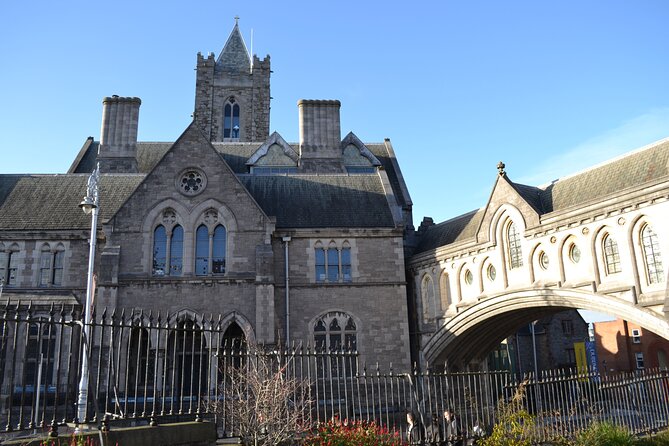
Temple Bar receives about 20 minutes, enough for a quick walk through one of Dublin’s best-known districts. The area covers roughly 28 acres and includes lanes, alleys, pubs, restaurants, and spaces linked to Irish traditional music.
The useful angle here is that Temple Bar is more than one pub with a famous sign. David can point out the side streets and explain the area’s older stories, while also helping you understand how the district works today.
You should keep your expectations in check. Twenty minutes is not enough to settle in for live music or a full meal, and anything you buy is your own expense. Still, the stop is valuable early in a Dublin visit because it helps you decide when to return and where you may want to spend an evening.
The route also includes Dublin’s Music Wall of Fame. This 15-minute stop celebrates Irish singers and bands who made their mark at home and around the world. It adds a lighter cultural note after the political material, and David is known for using his singing and enthusiasm to make Dublin’s music tradition more personal.
A few more Dublin tours worth weighing up
- All Dublin 3 hours italian walking tour
★ 4.8 · 16 reviews
Crossing the Ha’penny Bridge

The Ha’penny Bridge is one of Dublin’s classic photo stops. The wrought iron footbridge links the north and south sides of the River Liffey and has served the city for more than 200 years.
You receive about 10 minutes here, enough to cross, pause, and take in views east and west along the river. The bridge is compact, so this is not a major time commitment. Its value comes from orientation: you see how the river divides and connects the city center.
I like this kind of stop because it turns a map into something you can understand with your feet. After crossing the bridge, you have a better sense of Dublin’s central layout and can more easily find your way back to places you want to revisit.
Powerscourt Townhouse and St Stephen’s Green

Powerscourt Townhouse Centre is one of the quieter stops on the route. The building began as an 18th-century city residence for Richard Wingfield, the second Viscount Powerscourt, and Lady Elizabeth. It later served as a social setting for Dublin’s wealthy families.
Today, the townhouse is a city shopping and dining center, but the building’s original purpose gives it a different feel from the surrounding streets. The tour allows about 10 minutes, so expect a short introduction and a look at the setting rather than a detailed interior tour.
St Stephen’s Green receives 15 minutes. This 22-acre park has gardens, flower beds, lakes, winding paths, sculptures, monuments, wildlife, and exotic plants. It is a welcome change from the hard surfaces and traffic of the city center.
The timing is brief for a park of this size. You will see only part of it, but David can explain why the Green matters to Dublin’s public life and Irish history. If you enjoy parks, plan to return for a longer walk. The tour gives you the orientation, not the full park experience.
Dubh Linn Gardens and the famine memorial
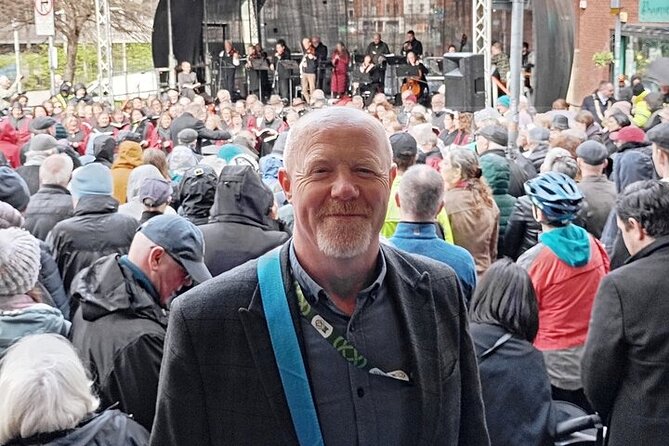
Dubh Linn Gardens is a small, tucked-away garden near Dublin Castle. It is often overlooked, and the 10-minute stop lets David explain its unusual name, brickwork, and Celtic patterns.
This is the sort of place a guide earns their fee by showing you. You could pass close by without realizing the garden has its own story. The stop is short, but it adds variety and gives you a quieter pause between larger landmarks.
The Edward Delaney Famine Memorial brings the mood down sharply, and appropriately so. The sculptures show emaciated figures and honor more than one million people who died during the Great Irish Famine beginning in 1845. The famine also caused widespread displacement and helped shape the large Irish diaspora around the world.
You receive about 10 minutes here. That is enough for a respectful explanation and a moment to look closely, though the subject is too serious for a rushed treatment. I appreciate that the route does not present Dublin as only cheerful pubs and music. Irish history includes grief, political failure, hunger, and forced movement, and this stop makes that clear.
Wolfe Tone, Dame Lane, and the 1916 Rising
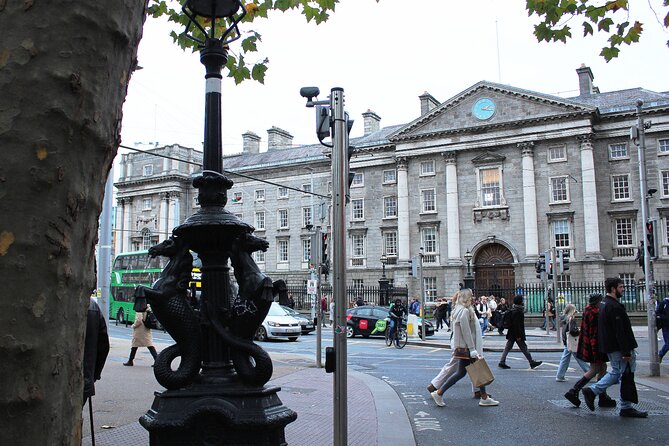
The Theobald Wolfe Tone statue introduces another major political figure. Tone is remembered as a leading figure in the push for Irish independence and is often called the father of Irish nationalism. He played a major role in the 1798 rebellion.
The 10-minute stop is a compact lesson in Ireland’s resistance to British rule. David’s broader historical approach is useful here because the route does not treat the 1798 rebellion and the 1916 Rising as isolated events.
At Dame Lane, you examine a copy of the Irish Proclamation, issued on April 24, 1916, during the Easter Rising. The document declared an independent Irish Republic and spoke of equal citizenship and respect for people’s rights.
This stop gives the tour a clear modern political focus. If you are unfamiliar with Irish history, the short explanations across Dublin Castle, Wolfe Tone, and the Proclamation help you see how the city’s streets connect to larger national events.
The route’s historical coverage is one of its strongest features. You get medieval Dublin, British administration, political rebellion, famine, nationalism, and modern Irish cultural identity in one walk. The trade-off is that no single subject gets a long lecture.
What David adds to the walk
David is the named guide, and the experience depends greatly on his style. He brings facts, dates, humor, photographs, and other items in a portfolio. He also uses songs, which suits a city where music and storytelling are part of public life.
His background covers Dublin and Irish history, architecture, geography, politics, art, literature, and folklore. That range matters because the route jumps between buildings, statues, gardens, political movements, and music. You are not getting only a standard monument-by-monument explanation.
The personal format also makes a difference. You can ask about something that catches your attention, request more detail on politics or music, and discuss where to go afterward. David has also been praised for staying in close contact when delays affected an arrival and for adding a little extra time when needed, but you should still plan around the advertised three-hour duration.
At the end, you receive a digital PDF with recommendations for cafes, restaurants, pubs, and traditional music venues. You also get advice on transport and navigating Dublin. That follow-up material adds value if this is your first day in the city, since you can use the tour to plan the rest of your stay.
Price, timing, and practical value
The price is $144.03 per person. For one or two people, that is a sizable spend for a three-hour walk. For a larger private group, the per-person cost may feel more reasonable, especially if you value a dedicated guide rather than a fixed public tour.
The important question is what you want from the money. You are paying for David’s time, a private route, historical interpretation, orientation advice, and restaurant and music suggestions. You are not paying for attraction admission, food, drinks, or a long visit inside any major site.
Pickup is offered from listed hotels, city-center accommodation, or the central meeting point at the Molly Malone statue. The usual ending is College Green, but the tour can be adjusted to finish somewhere more useful for your plans. The supplied example is a route ending near Christ Church Cathedral for someone heading to the Guinness Storehouse, though any adjustment should be arranged in advance.
The tour is offered in English, includes a mobile ticket, and confirmation arrives at booking. It is near public transportation, and service animals are allowed. Most people can take part, but it is not recommended for babies or children under five.
Free cancellation is available up to 24 hours before the start time for a full refund. Changes or cancellations inside that window are not accepted, so check your plans before the deadline.
Who will get the most from this Dublin walk
I would choose this tour for a first visit, especially if you want to understand central Dublin before exploring it alone. It is also a good fit for couples, families with older children, cruise passengers, and small groups who want a route shaped around their own interests.
History fans will appreciate the links between the castle, Parliament House, Wolfe Tone, the Famine Memorial, and the 1916 Proclamation. Music lovers may enjoy the Wall of Fame, David’s singing, and the separate recommendations for traditional music venues.
You should think twice if you prefer long indoor visits or a slow photographic walk. The route has fourteen stops, so you will often spend 10 to 20 minutes at a place before moving on. It also requires walking through the city, and the tour does not include refreshments or paid entries.
Should you book it?
Book this private Dublin walking tour if you want a lively three-hour introduction led by David, with serious history balanced by music, humor, and local recommendations. Its best feature is the connection between places that can otherwise feel like unrelated sights.
The price makes the most sense for a group that can share the private experience, or for anyone who places a high value on personal attention and flexible planning. If you want to tour the interiors of Dublin Castle or Trinity College, add those visits separately. If you want a fast but thoughtful introduction to Dublin’s past and present, this is a strong choice.
FAQ
How long is the Dublin Private Walking Tour?
The tour lasts approximately three hours.
Where does the tour start?
It starts at the Molly Malone Statue on Suffolk Street, Dublin 2. Pickup can also be arranged from listed hotels or city-center accommodation.
Where does the tour end?
The usual end point is College Green in Dublin. You may request a different convenient end point for your itinerary.
Is the tour private?
Yes. Only your group participates in this private activity.
Is Dublin Castle included inside the tour?
The Dublin Castle stop is an exterior tour. Admission is not included.
Does the tour enter Trinity College?
The tour includes an external walk through the grounds of Trinity College. Paid attraction entry is not included.
Are food and drinks included?
No. Food and drinks are not included in the tour price.
Is the tour suitable for young children?
It is not recommended for babies or children under five years old. Most other participants can take part.
What language is the tour offered in?
The tour is offered in English.
Can I cancel for a refund?
You can cancel at least 24 hours before the start time for a full refund. Cancellations or changes made less than 24 hours before the tour are not accepted.
Just added around Dublin
- Dublin: Pub Tour. Pour The Perfect Guinness, Whiskey & Music★ 5.0 · 3 reviews
- A Self Guided Walking Tour of Dublin’s Docklands★ 4.5 · 3 reviews
- Private Dublin City tour★ 5.0 · 3 reviews
- Dublin One Day Tour with a Local: 100% Personalized & Private★ 4.5 · 3 reviews
- Waterford Crystal and Kilkenny Full-Day Rail Tour from Dublin★ 5.0 · 3 reviews
- Secret and unusual Dublin: guided walking tour★ 5.0 · 3 reviews
- 5 Day Ireland’s South−East Including Admission from Dublin★ 4.5 · 3 reviews
- Turtle Bunbury’s Dublin: A Self-Guided Audio Tour from a Celebrated Author★ 5.0 · 3 reviews
Walking Tours, compared.
Dublin Highlights and Hidden Gems Guided Walking Tour
Read our review →
90 Minute Dublin Walking tour and Sightseeing tips
Read our review →

Dublin Traditional Irish 3 Course Meal Walking Tour with Local
Read our review →

Browse the lists this tour appears in