
Reviewed · SELF-GUIDED TOURS
A Self-Guided Stroll Along Dún Laoghaire’s East Pier
Dún Laoghaire’s East Pier gives you a fine mix of harbor views and Irish history without the price or schedule of a conventional guided tour. Starting at St Michael’s Church, you follow the town’s old railway route, pass memorials and monuments, and finish by the water near the Roger Casement Statue.
I like the offline VoiceMap access, which means you can listen and follow the map without relying on a live data connection. I also like the compact length: one hour to one hour and 15 minutes gives you a useful introduction to Dún Laoghaire without consuming half your day. The main drawback is that this is an app-based walk, so you need your own charged smartphone and headphones, and the non-refundable booking policy leaves little room for a change of plan.
In This Review
- Key points to know before you go
- Why Dún Laoghaire works so well for a self-guided walk
- Starting at St Michael’s Church on Marine Road
- The Pavilion Theatre and Dún Laoghaire’s modern side
- Monuments that connect Dún Laoghaire to wider events
- Walking the Metals, a railway route turned promenade
- Reaching the East Pier Lighthouse and Dublin Bay
- Carlisle Pier and the Forgotten Irish Memorial
- The East Pier Bandstand Sun Shelter
- The Crimean War cannon and its Romanov eagle
- Ending near Roger Casement’s statue
- Is $8.99 good value for this Dún Laoghaire walk?
- Who should book this self-guided East Pier experience?
- Should you book it?
- FAQ
- Where does the Dún Laoghaire audio walk start?
- Where does the tour finish?
- How long does the walk take?
- What language is the tour offered in?
- What app is used for the experience?
- Can I use the tour offline?
- Do I need to bring my own phone and headphones?
- Is the tour private?
Key points to know before you go
- The route links old Dún Laoghaire with its modern waterfront, moving from St Michael’s Church and the Pavilion Theatre to the East Pier.
- The Metals tell the story of the former railway, now used as a walking route through town.
- The East Pier Lighthouse offers the best visual payoff, with broad views across Dublin Bay and toward the city.
- Several memorials add weight to the walk, including the RMS Leinster Memorial and the Forgotten Irish Memorial.
- The Crimean War cannon has a striking Romanov eagle, an unexpected Russian connection in an Irish harbor.
- The tour costs $8.99 per person, a reasonable price if you want structure and context but prefer to walk independently.
Why Dún Laoghaire works so well for a self-guided walk
Dún Laoghaire is easy to appreciate on foot because its story is written into a fairly compact area. You move from church and civic buildings to theaters, railway remains, harbor structures, memorials, and open sea views. The route does not depend on a single grand sight. Instead, it shows how a coastal town changed over time.
That makes the audio format a good fit. You can look around while the app supplies the background, rather than stopping at every plaque to read small blocks of text. The walk is private for your group, so you are not tied to a guide’s pace or sharing the experience with strangers.
The route is offered in English through the VoiceMap app for Android and iOS. Your purchase includes lifetime access, plus offline audio, maps, and geographic data. Downloading the material before you start is still a sensible step, even though offline use is included.
The stated duration is about 60 to 75 minutes. I would allow extra time if you want photographs at the pier, pause at the memorials, or stop for food near the end. The opening hours are listed as all day, every day, from February 14, 2024, through February 7, 2027, so you have plenty of flexibility.
More self-guided routes in Dublin:
- St Patrick’s Cathedral: Self-Guided Cathedral Admission
★ 4.5 · 2,126 reviews - Christ Church Cathedral Entrance Ticket & Self-Guided Tour
★ 4.6 · 773 reviews - Dublin Ghost Hunt Exploration Game and Tour
★ 4.0 · 34 reviews
Starting at St Michael’s Church on Marine Road

The walk begins at St Michael’s Church on Marine Road. Established in the 1820s, the church gives you an immediate sense that Dún Laoghaire is more than a modern seaside stop. It points to a settled local community that was already taking shape before the harbor became the town’s defining feature.
This is a useful starting place because it lets the story unfold in time as well as space. You begin with local religious and civic life, then move toward the port and the sea. I find that kind of sequence more satisfying than being dropped straight onto a pier with no explanation of how the town developed around it.
The meeting point is near public transportation, and most people can take part. Service animals are allowed. The tour is private, but it is not a live private guide, so the privacy comes from using the audio experience with only your own group.
Bring comfortable shoes. The route is a walking tour, and the pier section is the part where you will likely want to slow down rather than rush through.
The Pavilion Theatre and Dún Laoghaire’s modern side
From the church, the route passes the Pavilion Theatre. This contemporary cultural venue provides a useful contrast with the older buildings and harbor structures nearby. The point is not simply to collect old monuments. You are also seeing how Dún Laoghaire continues to function as a town with present-day arts and entertainment.
I like this stop because it keeps the walk from becoming a string of memorials. The theater shows that the area’s identity is not frozen in the past. The audio commentary can help you notice how newer public spaces fit beside older town features.
The route is not presented as a museum tour, and that matters. You are walking through an active place, with modern life taking place around the historical material. Keep your attention on the surroundings as well as the phone. Audio tours work best when the screen stays in your pocket as much as possible.
Monuments that connect Dún Laoghaire to wider events

The King George IV Monument and the RMS Leinster Memorial shift the focus from local development to larger national and international events. The first reflects the town’s connection with royal history. The second recalls the sinking of the RMS Leinster during World War I.
The RMS Leinster Memorial is one of the more serious moments on the route. The disaster was one of Ireland’s deadliest maritime tragedies, and the memorial honors the people who died. It also shows why the harbor was not just a pleasant place for a stroll. It was a working gateway used by ships, passengers, and communities affected by events far beyond Dublin Bay.
You may find this part of the walk more reflective than scenic. That is a strength if you want historical context rather than only postcard views. Families with young children may want to explain the war connection in simple terms, since the memorial deals with loss.
The King George IV Monument adds another layer. Together, these stops show Dún Laoghaire’s changing connections with monarchy, shipping, war, and Ireland’s own public memory.
A few more Dublin tours worth weighing up
- Dublin Highlights and Hidden Gems Guided Walking Tour
★ 5.0 · 6,020 reviews - Dublin to Glendalough, Wicklow and Kilkenny Full Day Guided Tour
★ 5.0 · 4,895 reviews - Dublin Book of Kells, Castle and Molly Malone Statue Guided Tour
★ 4.5 · 3,825 reviews - The Little Museum of Dublin Famous Guided Tour
★ 5.0 · 2,948 reviews
Walking the Metals, a railway route turned promenade
The Metals are remnants of the old railway track, now used as a promenade. This is one of the most distinctive features of the walk because the route itself becomes part of the story. You are not merely hearing about transportation changes. You are walking along a surviving trace of the system that helped turn a fishing village into a major port town.
Railway remains often look modest at first. Without explanation, you might simply see a path. The audio gives that path a purpose and helps you connect the town’s physical layout with its economic growth.
This section also gives the route a pleasant change of pace. After churches, monuments, and a theater, you get a linear walk toward the harbor. The Metals help explain why Dún Laoghaire grew where it did and why transport mattered so much to its future.
One practical point: the walk’s route and stop descriptions include several places close to one another, but the exact turns are best followed through the VoiceMap map. Download the map and geodata before setting out, especially if you want to keep your phone offline.
Reaching the East Pier Lighthouse and Dublin Bay
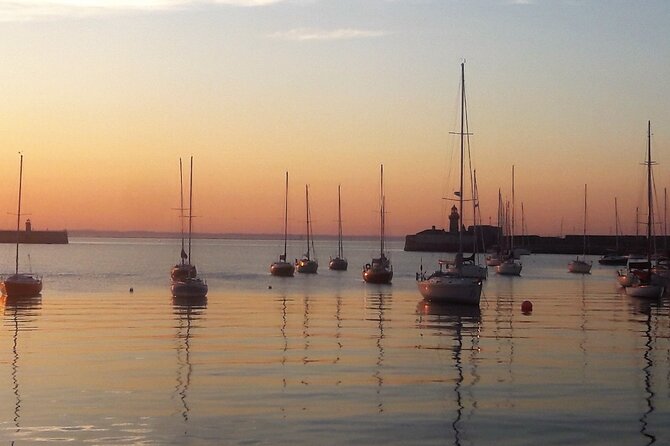
The East Pier is the main scenic reward. As you walk toward the East Pier Lighthouse, the town opens out into wide views of Dublin Bay and the city. This is the moment when the earlier discussion of the harbor becomes physical. You can see the waterway that shaped Dún Laoghaire’s fortunes.
The audio explains the harbor’s construction and its role in Ireland’s story. That context improves the view. Instead of seeing only a long stone walkway and a lighthouse, you begin to understand the scale of the work involved and the reasons the harbor mattered.
The pier is also where you should build in extra time. The listed duration is an estimate, not a command. Pause for photographs, look back toward the shore, and let the scenery do some of the work. The walk is short enough that you do not need to hurry.
The route is especially appealing if you want a coastal experience without committing to a long hike. You get open water, harbor architecture, and city views in a manageable outing. The tradeoff is that the experience depends heavily on weather. On a gray or windy day, the historic material may carry more of the visit than the views.
Carlisle Pier and the Forgotten Irish Memorial
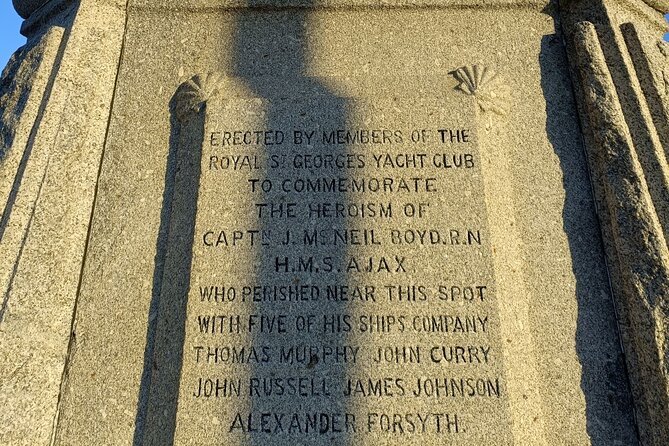
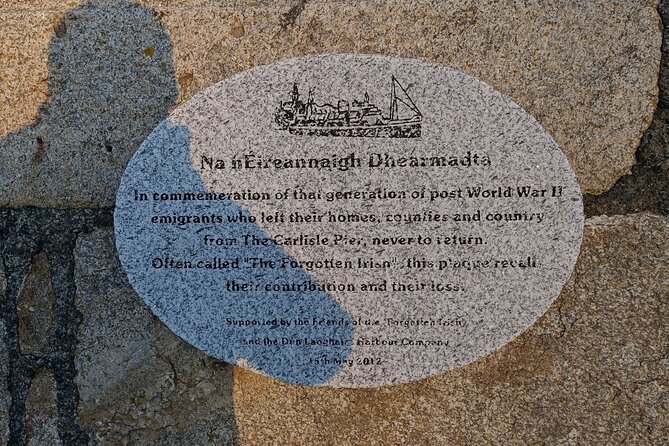
Carlisle Pier dates from the 1820s and offers another link to Dún Laoghaire’s seafaring past. It helps you picture the harbor as a place of departure and arrival, not simply a leisure area. The pier reflects the town’s long connection with ships and the steady changes that followed.
Nearby, the Forgotten Irish Memorial honors Irish emigrants. Its subject gives the walk a broader human dimension. People leaving Ireland for new opportunities faced uncertainty, distance, and the challenge of building a life far from home. The memorial keeps those journeys connected to this waterfront.
I appreciate the pairing of the old pier and the emigration memorial. One gives you a physical reminder of maritime travel. The other asks you to think about the people whose lives were shaped by leaving Ireland. This is a good example of why an audio walk can add value to an ordinary public space.
Do not expect a large museum or a long stop here. These are outdoor points of interest, and the commentary supplies the links between them. If you prefer highly visual attractions with interiors to explore, this section may feel understated.
The East Pier Bandstand Sun Shelter
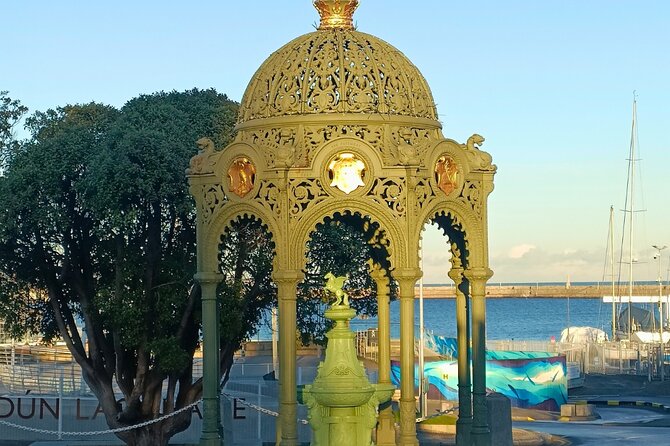
The East Pier Bandstand Sun Shelter brings a lighter architectural note to the harbor walk. Its unusual design gives you something to notice beyond the water, the lighthouse, and the memorials.
This stop also shows how public recreation became part of the pier’s life. Harbor spaces serve many purposes: shipping, transport, remembrance, exercise, and leisure. The shelter belongs to that everyday side of Dún Laoghaire.
The route does not treat every stop as a major monument. That is worth understanding before booking. Some points are meaningful because of their setting and connection to the larger story, not because they are grand attractions in themselves.
The Crimean War cannon and its Romanov eagle
The Crimean War cannon is one of the walk’s most unexpected details. Look for the eagle motif of the Romanov family. The cannon’s presence in Dublin opens a curious connection between an Irish harbor and Russia.
This is exactly the kind of small detail that can make a self-guided walk worthwhile. You might pass the cannon without knowing why it is there. Once the audio explains its background, the object becomes part of a wider story about war, empire, symbols, and the movement of military equipment.
The cannon also breaks up the solemn tone created by the RMS Leinster Memorial and the Forgotten Irish Memorial. The route keeps shifting between grand events and individual objects. That variety helps maintain interest during a short walk.
Ending near Roger Casement’s statue
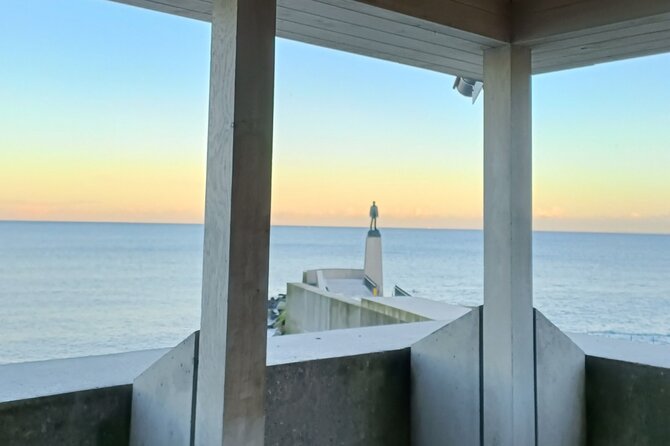
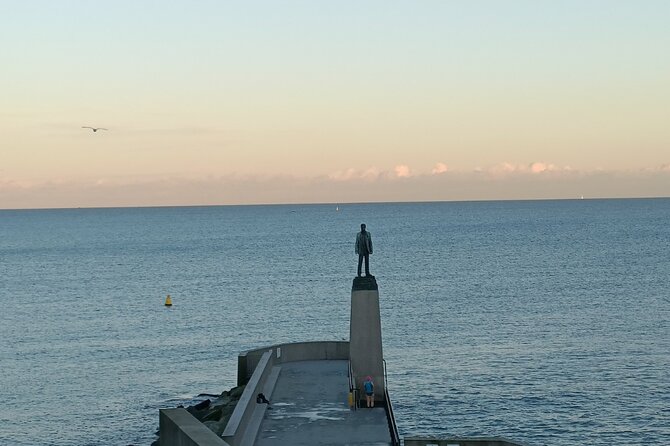
The route description places the finish near the Roger Casement Statue. Casement is honored as an Irish revolutionary, so the final stop brings the walk back to Ireland’s political struggle and its strong tradition of resistance.
That ending gives the experience a clear arc. You begin with a local church, pass through royal and maritime connections, follow the remains of a railway, and finish with a figure linked to Irish nationalism. Dún Laoghaire emerges as a place shaped by outside powers, local enterprise, emigration, war, and rebellion.
Nearby eateries make it easy to continue your visit after the audio ends. The supplied information does not name particular restaurants, so I would treat this as a general opportunity rather than plan around a specific venue.
There is one point to clarify before you set off. The stop-by-stop description places the end near the Roger Casement Statue, while the meeting information says the activity ends back at the starting point. Use the app’s final route instructions on the day, and allow a little extra time if returning to St Michael’s Church is required.
Is $8.99 good value for this Dún Laoghaire walk?
At $8.99 per person, this is priced as a low-cost introduction rather than a full guided excursion. You are paying for the audio content, route, map, and the freedom to use the tour at your own pace. Lifetime access is a useful bonus if you expect to return to Dublin or want to repeat sections later.
The value is strongest for independent visitors who want more than a random waterfront walk. The route provides a clear order and historical links, while the offline function removes the need to keep checking a connection.
It is less attractive if you already know Dún Laoghaire well, dislike listening to commentary through headphones, or want a guide who can answer questions. You also need to supply the smartphone and headphones, and food, drink, and transportation are not included.
The tour does not appear to require a full day or advance transport planning. That makes it easy to add around other Dublin plans. Still, the non-refundable policy matters. Book only when you are confident you can use it, since cancellations or amendments do not receive a refund.
Who should book this self-guided East Pier experience?
I would recommend it to first-time visitors to Dún Laoghaire, independent walkers, couples, and small private groups who enjoy setting their own pace. It also suits anyone who wants a short coastal outing with historical context instead of a formal indoor attraction.
The route should work for most people, and service animals are allowed. The supplied information does not give detailed measurements of slopes, surfaces, or step-free access, so contact the provider if you need specific mobility information before booking.
You should also be comfortable managing an app. VoiceMap provides the audio, maps, and geodata, but your phone battery and headphones are your responsibility. Download everything in advance and start with enough charge for the full walk.
The one available written comment is heavily garbled and auto-translated, so it offers no useful detail about a particular guide or stop. I would place more weight on the clearly defined route, offline access, short duration, and the 4.5 overall rating from six published ratings than on that unclear sentence.
Should you book it?
Book this tour if you want an affordable, flexible way to understand Dún Laoghaire while walking to the East Pier. The best parts are the link between the Metals and the harbor, the Dublin Bay views, and the succession of memorials that give the waterfront emotional weight.
Skip it if you want a live guide, a highly interactive group experience, or a tour with indoor entries and included refreshments. For everyone else, $8.99 is a fair price for a focused hour of local history, provided you bring your own phone, headphones, and a little patience for the weather.
FAQ
Where does the Dún Laoghaire audio walk start?
The tour starts at St Michael’s Church on Marine Road, Dún Laoghaire, County Dublin, Ireland.
Where does the tour finish?
The stop-by-stop route places the ending near the Roger Casement Statue. The meeting information also says the activity ends back at the starting point, so follow the final directions in the VoiceMap app.
How long does the walk take?
The expected duration is about one hour to one hour and 15 minutes.
What language is the tour offered in?
The tour is offered in English.
What app is used for the experience?
The tour uses the VoiceMap app, which is available for Android and iOS.
Can I use the tour offline?
Yes. Your purchase includes offline access to the audio, maps, and geographic data.
Do I need to bring my own phone and headphones?
Yes. A smartphone and headphones are not included, so bring your own equipment.
Is the tour private?
Yes. It is a private activity, and only your group participates.
Just added around Dublin
- Dublin: Pub Tour. Pour The Perfect Guinness, Whiskey & Music★ 5.0 · 3 reviews
- A Self Guided Walking Tour of Dublin’s Docklands★ 4.5 · 3 reviews
- Private Dublin City tour★ 5.0 · 3 reviews
- Dublin One Day Tour with a Local: 100% Personalized & Private★ 4.5 · 3 reviews
- Waterford Crystal and Kilkenny Full-Day Rail Tour from Dublin★ 5.0 · 3 reviews
- Secret and unusual Dublin: guided walking tour★ 5.0 · 3 reviews
- 5 Day Ireland’s South−East Including Admission from Dublin★ 4.5 · 3 reviews
- Turtle Bunbury’s Dublin: A Self-Guided Audio Tour from a Celebrated Author★ 5.0 · 3 reviews
Self-Guided Tours, compared.

St Patrick’s Cathedral: Self-Guided Cathedral Admission
Read our review →
Christ Church Cathedral Entrance Ticket & Self-Guided Tour
Read our review →
Dublin Self-Guided Murder Mystery Tour by Temple Bar
Read our review →
Dublin Old Town: Famous Pubs Exploration Game and Tour
Read our review →

The Dublin Incident: Alien, Whiskey & Clues Exploration Game
Read our review →Browse the lists this tour appears in