
Reviewed · DUBLIN CASTLE & CATHEDRAL TOURS
St Patrick’s Cathedral: Self-Guided Cathedral Admission
Saint Patrick’s Cathedral gives you more than a quick look inside an old church. Built in 1220 beside the well linked with Saint Patrick’s baptisms, it brings together Irish religion, politics, literature, art, and daily life under one Gothic roof. The audio guide helps you make sense of what you are seeing, while you remain free to linger.
I like the chance to see Jonathan Swift’s grave and cathedral artifacts, especially if Gulliver’s Travels is familiar to you. I also like the Discovery Space, where touch screens, choir recordings, and brass rubbing make the visit more engaging for children and curious adults.
The main consideration is time. This is a self-guided visit, and the cathedral contains a great deal to absorb. At busy times, the interior can feel crowded, and some visitors may wish for a printed guide focused on the stained glass and building work.
In This Review
- Key points to know before you go
- Why Saint Patrick’s Cathedral matters in Dublin
- Entering the cathedral and getting oriented
- Gothic stonework and stained glass
- Jonathan Swift’s grave and literary Dublin
- The Door of Reconciliation and an Irish expression
- The Discovery Space and hands-on history
- Self-guided freedom versus a live guide
- How long to stay and when to expect crowds
- Is the $12 admission good value?
- Accessibility and practical details
- Who should book Saint Patrick’s Cathedral?
- FAQ
- Where is Saint Patrick’s Cathedral located?
- How much does admission cost?
- How long is the visit?
- Is the visit self-guided?
- Which languages are available for the audio guide?
- What can I see inside the cathedral?
- Is Saint Patrick’s Cathedral wheelchair accessible?
- Can children visit without an adult?
Key points to know before you go

- Swift’s Dublin connection: See the burial place and artifacts linked to Jonathan Swift, dean from 1713 to 1745 and author of Gulliver’s Travels.
- A famous Irish doorway: The Door of Reconciliation inspired the expression to chance your arm.
- A useful audio guide: Handheld guides are included in English, French, German, Italian, Spanish, and Irish.
- Art you can study closely: Look for Gothic details, stained glass, and the 39-image window showing Saint Patrick’s life.
- History for younger visitors: The Discovery Space offers touch screens, choir samples, and brass rubbing.
- Simple access: Admission costs $12 per person, is valid for one day, and the cathedral is wheelchair accessible.
Why Saint Patrick’s Cathedral matters in Dublin
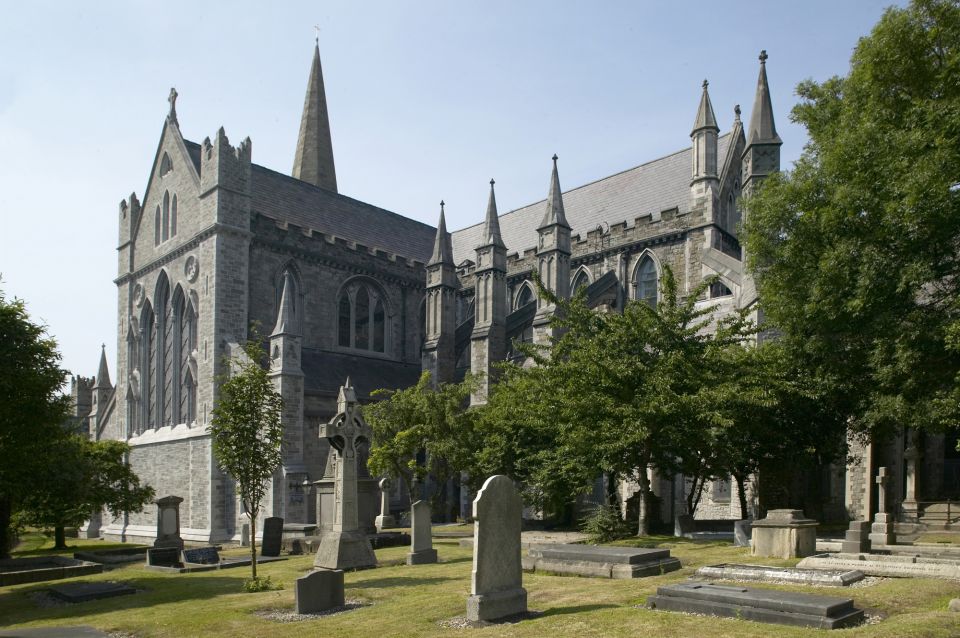
Saint Patrick’s Cathedral is the largest cathedral in Ireland and one of the country’s key pilgrimage sites. Its importance is not only religious. The building has been tied to Irish public life and culture for more than 800 years.
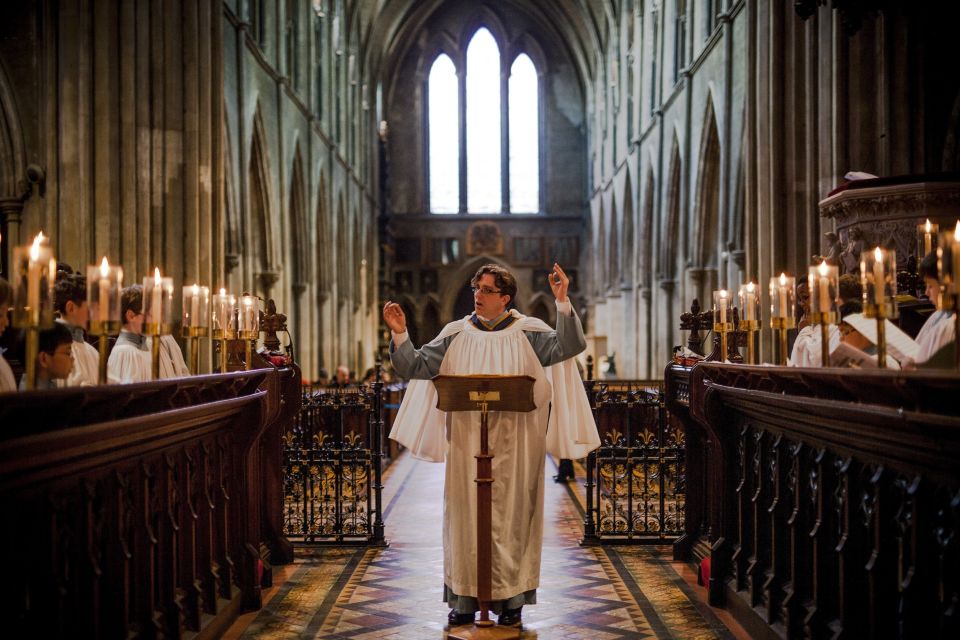
Tradition places Saint Patrick’s baptismal well beside the cathedral. The present building was begun in 1220 in honor of Ireland’s patron saint. Today it is the National Cathedral of the Church of Ireland, and sung services take place twice daily from Sunday through Friday.
That active role changes the feel of the visit. You are not entering a museum built only for sightseeing. You are entering a working place of worship that also welcomes people who want to understand Irish history and architecture.
I find that this gives the cathedral more weight than a simple photo stop. You can admire the stonework, then notice signs of present-day worship, music, and quiet reflection. Please keep that in mind as you move through the building, particularly if a service or choir activity is taking place.
More Dublin castle and cathedral visits:
- Dublin: Fast-Track Book of Kells Ticket & Dublin Castle Tour
★ 4.5 · 1,661 reviews - St Patrick’s Cathedral, Book of Kells and Dublin Castle Tour
★ 4.5 · 882 reviews - Christ Church Cathedral Entrance Ticket & Self-Guided Tour
★ 4.6 · 773 reviews
Entering the cathedral and getting oriented
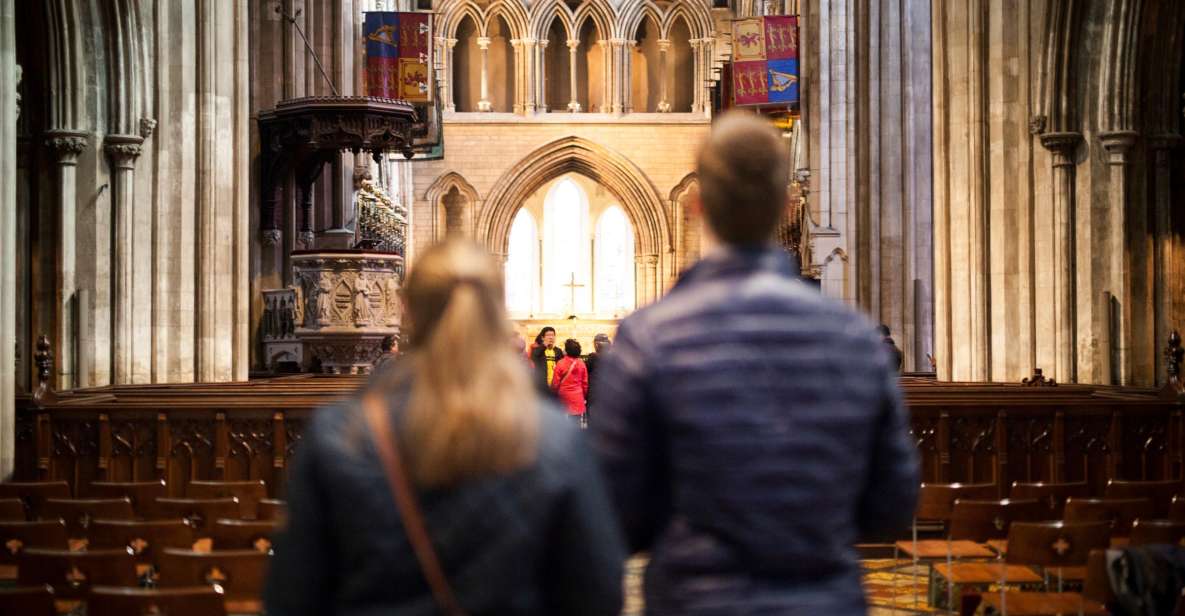
The visit begins at Saint Patrick’s Cathedral and ends there, so you can fit it neatly into a day of exploring central Dublin. Admission is self-guided, with the ticket valid for one day. There is no fixed tour duration, which is useful if you want to work around lunch, a museum visit, or a service.
The included audio guide is the practical heart of the experience. You can listen in English, French, German, Italian, Spanish, or Irish. Several visitors found the handheld guide clear and easy to use, and some preferred connecting their own headphones. If you have wired headphones, bring them, since they can make listening simpler and more comfortable.
You do not need to hear every recording. The best approach is to move at your own pace, stop for the explanations that interest you, and keep walking when a topic is less relevant. That freedom is one of the strongest reasons to choose this admission instead of a tightly timed tour.
Guides may also be available inside the cathedral at set intervals. If you arrive at the wrong moment, the audio guide means you can begin immediately rather than wait. If you meet a guide such as David or Anna, you may prefer asking questions and hearing the story in person.
Gothic stonework and stained glass
The first thing likely to catch your eye is the building itself. Saint Patrick’s combines tall Gothic forms, carved stone, pointed arches, and colored glass. The interior is maintained with care, so the details are easier to appreciate than they would be in a dim or neglected historic building.
Take your time looking upward and across the nave. Churches can overwhelm you with decoration, but the audio guide gives you a reason to pause at particular features. It helps turn a general impression of beautiful old church into a clearer understanding of why the structure matters.
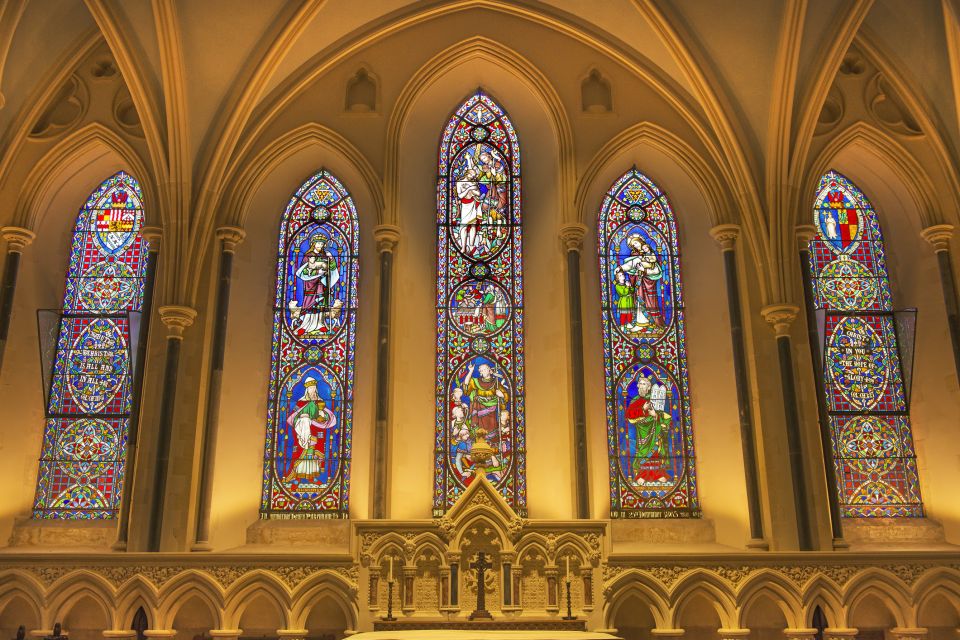
The stained glass deserves special attention. One window presents the life of Saint Patrick in 39 images. That sequence gives you a visual way to follow the saint’s story, even if you do not know much about him before arriving.
I recommend standing back first to see the full design, then moving closer to study the individual panels. The colors and small scenes reward patience. A printed booklet devoted to the windows would be useful, but none is listed as part of the admission, so use the audio guide and the on-site explanations to fill in the details.
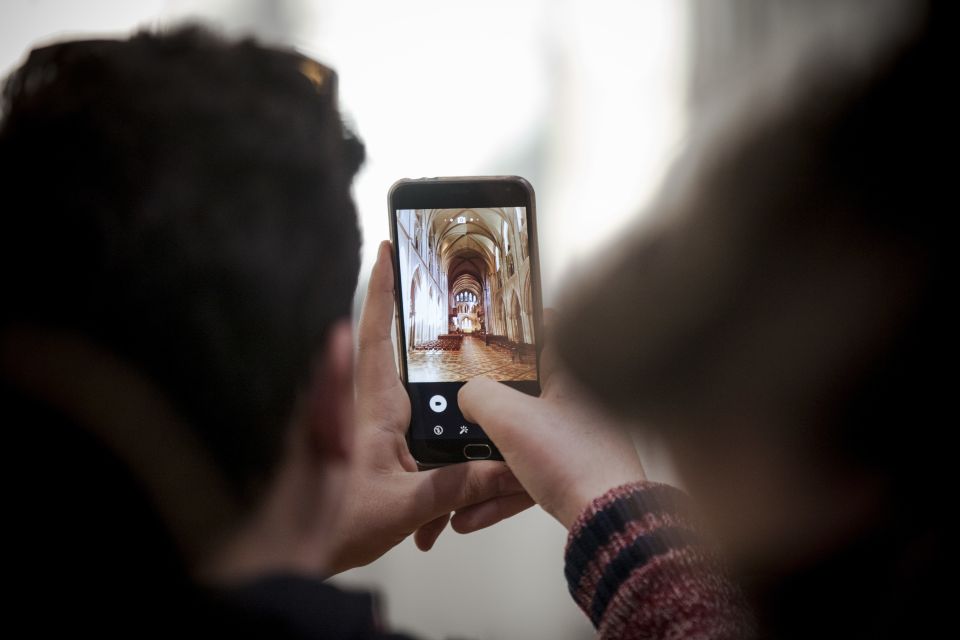
Photography can be tempting at every turn. Still, the best visit is not just a search for attractive pictures. Look for how the glass, stone, and light work together, and leave room for the cathedral’s quieter mood.
Jonathan Swift’s grave and literary Dublin
Saint Patrick’s Cathedral is closely tied to Jonathan Swift, the author of Gulliver’s Travels. Swift served as dean from 1713 to 1745 and is buried in the cathedral.
His connection gives the building a strong literary interest. You are not simply seeing the final resting place of a famous writer. You are seeing the church where he held a senior role for more than three decades.
Artifacts connected with Swift are also displayed. These help place his life within the cathedral rather than treating his grave as an isolated memorial. If you know Gulliver’s Travels, this part of the visit adds a memorable Dublin link to a work read around the world.
The Swift material is especially useful for visitors who want a story about a person, not only a building. Architecture can be hard to take in all at once. A grave, a name, and objects connected with a recognizable writer give you a human point of focus.
More self-guided routes in Dublin:
- Dublin Ghost Hunt Exploration Game and Tour
★ 4.0 · 34 reviews - Private Dublin Treasure Hunt Self Guided Tour
★ 4.5 · 14 reviews - Dublin Self-Guided Murder Mystery Tour by Temple Bar
★ 3.5 · 12 reviews - Dublin Old Town: Famous Pubs Exploration Game and Tour
★ 4.0 · 7 reviews
The Door of Reconciliation and an Irish expression
Watch for the Door of Reconciliation. It is linked with an event that gave rise to the Irish expression to chance your arm.
The phrase comes from a story of two rival families. The door became part of an attempt to make peace, with an arm reaching through an opening as a sign of trust. The detail is easy to remember because it connects a physical feature with language still associated with Ireland.
This is the kind of small stop that makes a self-guided visit worthwhile. You can walk past a doorway without noticing it, but once you know its story, it becomes one of the cathedral’s most distinctive details.
Use the audio guide to hear the explanation, then look closely at the door and its setting. It is a good example of how the cathedral preserves more than religious history. It also holds stories about conflict, compromise, and the way historical events enter everyday speech.
The Discovery Space and hands-on history
The Discovery Space adds a modern layer to the old building. Touch-screen technology explains parts of the cathedral’s long past, while iPads offer samples of the choir.
That is useful when the architecture alone begins to feel like too much information. You can interact with the material instead of only reading labels. The choir recordings also help you picture the cathedral as a place of music and worship, not just stone and glass.
A brass rubbing gives children and adults a hands-on activity. It is a small feature, but it can make the visit more memorable for families. Younger visitors may also receive an activity book, depending on what is offered during the visit.
I would give the Discovery Space extra time if you are visiting with children. It breaks up the visual tour and gives them something to do with their hands. Adults who enjoy church history can also use the touch screens to connect architectural features with dates and events.
Self-guided freedom versus a live guide
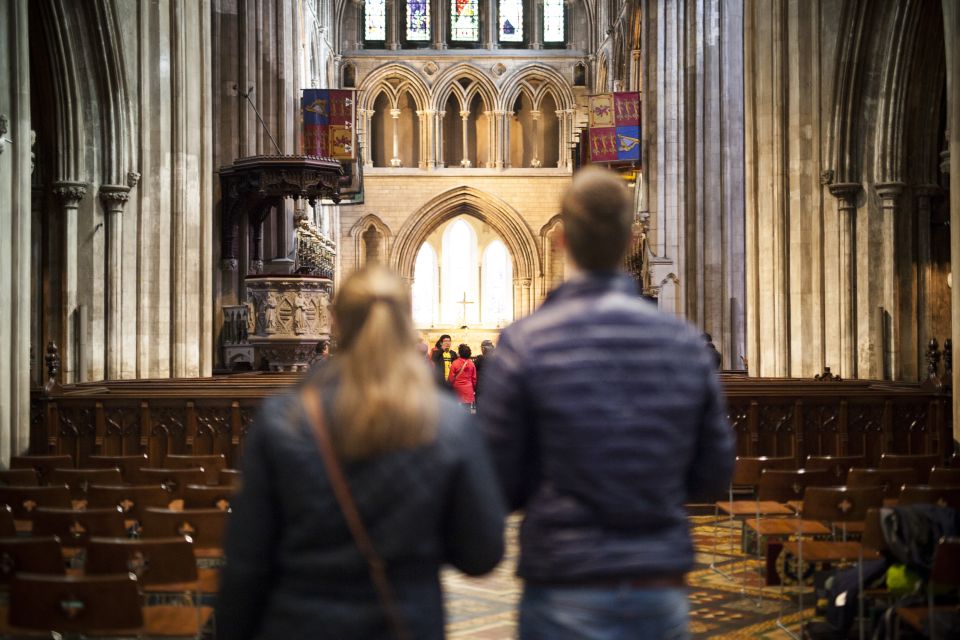
The self-guided format suits people who dislike being hurried. You can pause at Swift’s grave, spend several minutes with the Saint Patrick window, or skip sections that do not interest you.
The audio guide is detailed enough to provide structure. It also lets you choose the order and pace of your visit. That matters in a cathedral where your attention may shift between the nave, chapels, memorials, windows, and displays.
A live guide offers a different benefit. Guides such as David and Anna have been praised for explaining the building clearly and answering questions. A person can point out a detail you missed or adjust the explanation to your interests.
If a guided tour is available when you arrive, joining it may be worthwhile. The schedule can matter, though, and you may miss the next departure by only a few minutes. The self-guided option removes that problem.
For most people, I would use the audio guide first and speak with staff or a guide when a question comes up. That gives you both independence and human help without forcing the entire visit into one format.
How long to stay and when to expect crowds
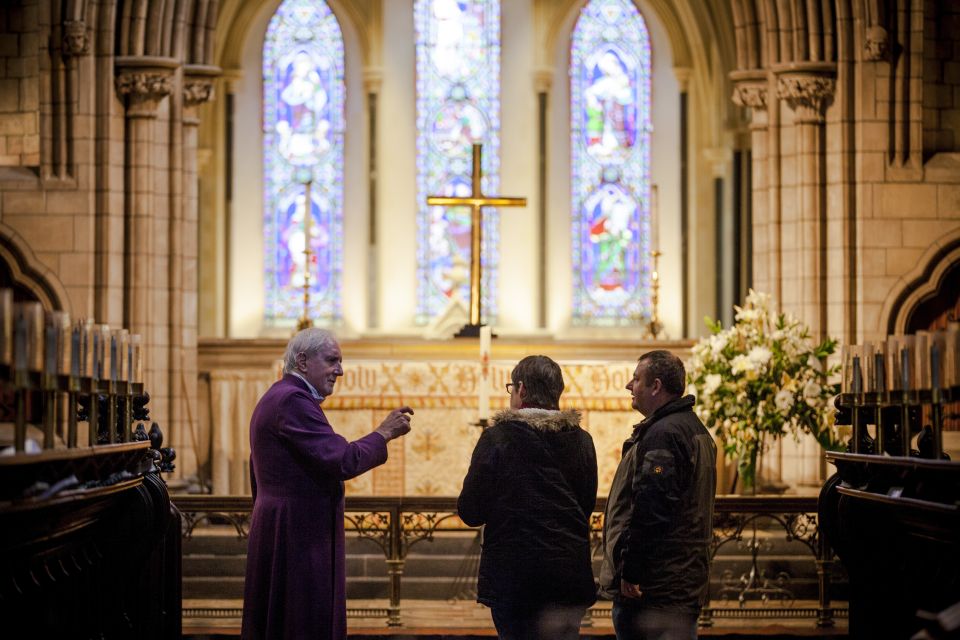
The ticket is valid for one day, but no fixed visit length is given. Your timing depends on how many audio stops you hear and how closely you study the building.
A quick visit could cover the main architectural features, Swift’s grave, the Door of Reconciliation, and the Saint Patrick window. If you listen to the full audio material, explore the Discovery Space, and pause for the choir recordings, you will need longer.
Around midday, especially during the busy summer season, the cathedral can become crowded. It may still be possible to enjoy the interior, but you will have less space for quiet observation and photographs.
The flexible ticket helps. You can check the available starting times before booking and plan around the rest of your Dublin day. Since this is a city attraction rather than a long excursion, it works well as part of a walking route through the capital.
Be respectful if services or choir activities are underway. The cathedral hosts sung services twice daily from Sunday through Friday, so the atmosphere may change during your visit.
Is the $12 admission good value?

At $12 per person, this is a reasonable Dublin admission, particularly because the price includes the audio guide. You are paying for access to one of Ireland’s most important historic churches, along with interpretation in six languages and the Discovery Space.
The value is strongest if you use the guide. Without it, you can still admire the architecture, but you may miss why the Door of Reconciliation matters, how Swift fits into the cathedral’s story, and what the Saint Patrick window presents.
The admission also gives you flexibility. You are not paying for a long coach outing or a fixed itinerary. You can spend as much or as little time as your day allows, though the experience rewards more than a rushed walk-through.
The drawbacks are modest. The shop may feel less suited to the solemn setting, and a printed guide devoted to the building or stained glass would improve the visit for some people. At busy times, crowding can also reduce the calm that makes a church visit special.
Still, the combination of architecture, literary connections, audio interpretation, and interactive displays makes the price fair. It is especially good value for families, first-time Dublin visitors, and anyone who wants context rather than only a grand interior.
Accessibility and practical details
Saint Patrick’s Cathedral is wheelchair accessible. Admission starts and ends at the cathedral, so there is no transport arrangement to manage as part of this activity.
You can reserve now and pay later, which helps if your Dublin plans are still shifting. Cancellation is free up to 24 hours before the visit for a full refund.
Anyone under 18 must be accompanied by a parent or guardian. Bring wired headphones if you prefer using your own, though the included audio equipment is available.
The experience does not list a meal, transport, or a separate walking route. Plan it as a focused cathedral visit, then continue elsewhere in Dublin on your own.
Who should book Saint Patrick’s Cathedral?
I would recommend this visit if you enjoy architecture, literature, and local stories in one place. It is also a good choice if you want a flexible attraction that does not tie up your whole day.
Families can make good use of the Discovery Space and brass rubbing. People interested in music may appreciate the choir samples, while readers will find Swift’s connection particularly rewarding.
You may want a different experience if you prefer a long, fully guided tour with a guide beside you at every point. The audio format is informative, but it asks you to choose where to stop and how much detail you want.
Book it if you want to understand what you are looking at, not simply photograph it. Skip it only if your Dublin schedule is so tight that you would have to hurry through the cathedral, or if historic churches are not part of your interests.
FAQ
Where is Saint Patrick’s Cathedral located?
Saint Patrick’s Cathedral is in Dublin County, Ireland. The activity begins and ends at the cathedral.
How much does admission cost?
Admission costs $12 per person.
How long is the visit?
The ticket is valid for one day, but no fixed visit duration is specified. You can choose your pace within the available opening and starting times.
Is the visit self-guided?
Yes. Self-guided admission is included, along with an audio guide. Guided tours may also be available at set times.
Which languages are available for the audio guide?
The audio guide is available in English, French, German, Italian, Spanish, and Irish.
What can I see inside the cathedral?
You can see Jonathan Swift’s burial place and related artifacts, the Door of Reconciliation, Gothic architecture, stained glass, and a window showing Saint Patrick’s life in 39 images.
Is Saint Patrick’s Cathedral wheelchair accessible?
Yes, the cathedral is wheelchair accessible.
Can children visit without an adult?
No. Anyone under 18 must be accompanied by a parent or guardian.
Just added around Dublin
- Dublin: Pub Tour. Pour The Perfect Guinness, Whiskey & Music★ 5.0 · 3 reviews
- A Self Guided Walking Tour of Dublin’s Docklands★ 4.5 · 3 reviews
- Private Dublin City tour★ 5.0 · 3 reviews
- Dublin One Day Tour with a Local: 100% Personalized & Private★ 4.5 · 3 reviews
- Waterford Crystal and Kilkenny Full-Day Rail Tour from Dublin★ 5.0 · 3 reviews
- Secret and unusual Dublin: guided walking tour★ 5.0 · 3 reviews
- 5 Day Ireland’s South−East Including Admission from Dublin★ 4.5 · 3 reviews
- Turtle Bunbury’s Dublin: A Self-Guided Audio Tour from a Celebrated Author★ 5.0 · 3 reviews
Dublin Castle & Cathedral Tours, compared.

Fast-Track Book of Kells Ticket & Dublin Castle Tour
Read our review →
St Patrick’s Cathedral, Book of Kells and Dublin Castle Tour
Read our review →
Christ Church Cathedral Entrance Ticket & Self-Guided Tour
Read our review →

Book of Kells, Dublin Castle and Christ Church Tour
Read our review →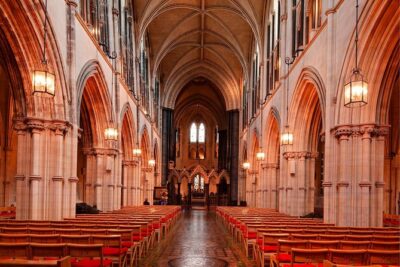
Dublin Christ Church Cathedral Admission Ticket
Read our review →
Dublin in a Day: Dublin Castle, Book of Kells, Guinness & Whiskey
Read our review →
St Patrick’s, Book of Kells, and Dublin Castle Tour
Read our review →Browse the lists this tour appears in